250 kVA Distribution Transformer (33kV)
Premium 250 kVA distribution transformer designed for large-scale power distribution across industrial zones and utility grids. Combines efficiency with robustness for continuous high-load operation.
Ref. DIST-250-33KV · Lead time 8–10 weeks · Made to order from Hapur
See full engineering specification & variants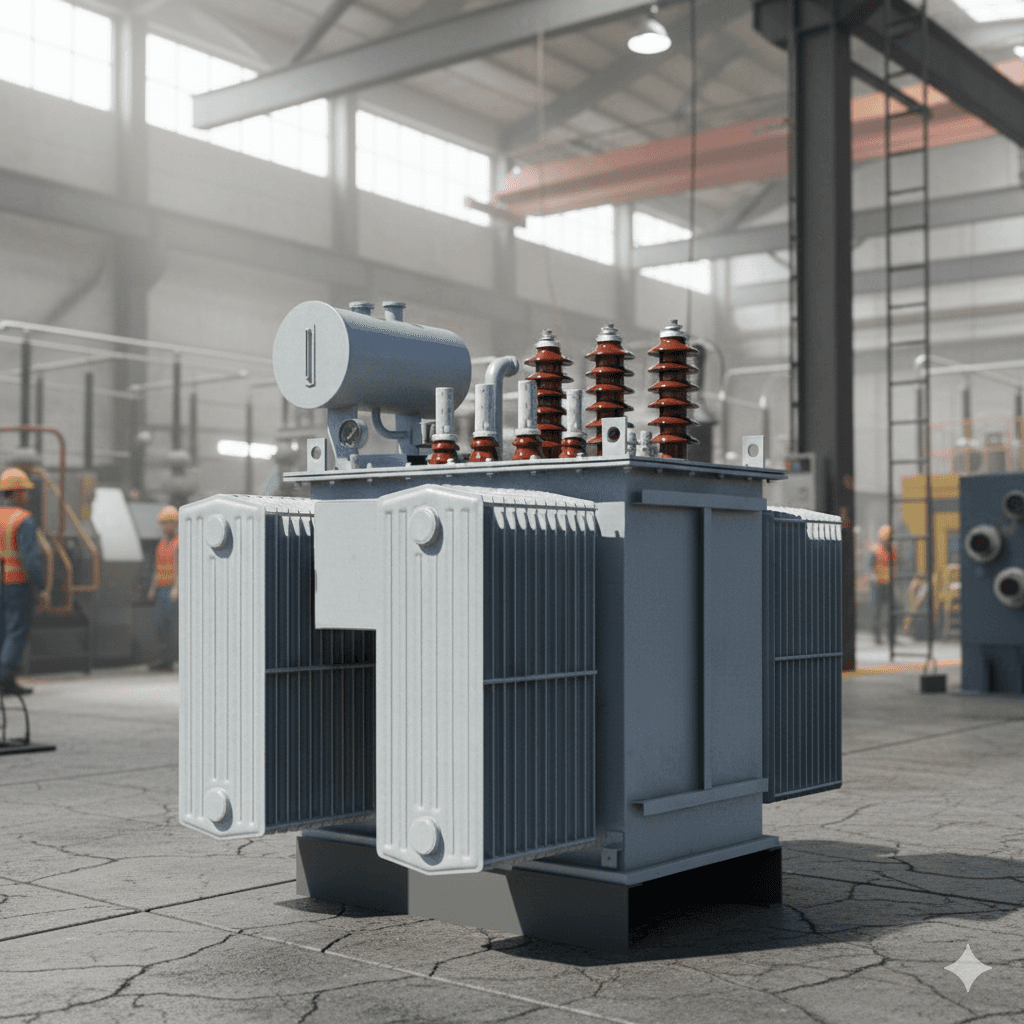
Key Features
Recommended For
Specifications
| Specification | Value |
|---|---|
| Capacity | 250 kVA |
| Primary Voltage | 33000V (±5%) |
| Secondary Voltage | 415V (±5%) |
| Frequency | 50 Hz |
| Tap Changer | On-load ±2 × 2.5% |
| Cooling Method | both air and oil cooled |
| Copper Loss | ~3000W |
| Iron Loss | ~1400W |
Reading the specification
What these numbers mean for your installation
A datasheet tells you what the unit does. This is what each figure changes about how you specify, feed and site it — worked out for the 250 kVA specifically, not the range in general.
12,264 kWh/year
Iron loss of 1,400 W is drawn whenever the transformer is energised, whether or not anything is connected. Over a year that is 12,264 kWh — about ₹98,112 at ₹8/kWh. It is the figure worth comparing between quotes, because you pay it for the full 25-year life regardless of load.
98.1%
At full load and 0.9 power factor, total losses of 4,400 W give roughly 98.1% efficiency. Copper loss varies with the square of load, so a transformer run at half capacity dissipates about a quarter of that 3,000 W — oversizing costs you standing loss, not copper loss.
33000V
At this capacity a 33 kV primary is the conventional choice rather than a constraint, and the HT yard is proportionate to the installation. Expect statutory clearances, 33 kV switchgear and metering, and a certified operator on the switching roster. The inspector's approval, not the transformer, is normally the critical path to energisation.
On-load ±2 × 2.5%
The tap changer trims the ratio across roughly 31.35–34.65 kV on the primary, which is what holds your 415 V board steady when the incoming supply sits persistently high or low. On-load switching matters at 250 kVA: you can retap without dropping the site, which on a load this size is the difference between a tap change and a shutdown.
Running-cost figures assume a reference industrial tariff of ₹8/kWh and continuous energisation. Substitute your own tariff and duty hours for a site-specific number — we will run it with you on request.
Sizing Guide
When is 250 kVA the right choice?
250 kVA is a plant-level rating for a site with its own substation — a full industrial unit, a utility distribution point serving several plots, a large commercial development, or a renewable tie-in. The ONAF option is the distinguishing feature at this size: fan-assisted cooling lets the same core run above its natural ONAN rating during summer peak, which is often what decides whether 250 kVA is genuinely sufficient or whether you need to go larger. Specify ONAF if your peak demand coincides with the hottest months, as most Indian industrial loads do. Below about 180 kVA of steady load the 160 kVA unit is the more economical choice on standing loss alone, and standing loss is what you pay for all 25 years.
Before you order
Where 250 kVA goes in, and what the site needs
Typical installations
We supply 250 kVA most often into large industrial parks, utility substations, power utility networks and large manufacturing facilities, alongside data center primary power and renewable energy tie-in points. What separates those sites is load factor. A transformer serving a steady process load and one serving a facility with a sharp evening peak have very different loss profiles over a year, even at an identical nameplate rating.
Statutory requirements
A 33 kV primary connection falls under CEA safety regulations: approved HT switchgear, earthing and statutory clearances, drawings submitted to the electrical inspector, and a certified operator for switching. Build that approval time into your programme — it routinely exceeds our 8–10 weeks manufacturing lead time, and it is the step that delays energisation far more often than the transformer does.
Adjacent ratings
If 250 kVA is not the right size
Sizing rarely lands exactly on a catalogue rating first time. These are the ratings either side of it in the same range — compare the specification before you commit.
160 kVA Distribution Transformer (33kV)
160 kVA distribution transformer for medium-scale grid integration.
View specificationDistribution Transformer100 kVA Distribution Transformer (33kV)
Heavy-duty 100 kVA distribution transformer for medium-voltage grid integration.
View specificationDistribution Transformer63 kVA Distribution Transformer (11kV)
63 kVA distribution transformer for medium-scale power distribution.
View specificationDistribution Transformer25 kVA Distribution Transformer (11kV)
Standard distribution transformer for 25 kVA load, 11kV primary voltage.
View specificationAlso in the transformer range
Different equipment rather than a different size — often specified alongside this on the same project.
50 kVA Three-Phase Ultra-Isolation Transformer
Industrial three-phase ultra-isolation transformer with advanced noise suppression.
View specificationIsolation Transformer20 kVA Three-Phase Isolation Transformer
Three-phase 20 kVA isolation transformer for medium-load equipment protection.
View specificationIsolation Transformer10 kVA Single-Phase Isolation Transformer
High-isolation single-phase transformer for sensitive electronic equipment protection.
View specificationEngineering detail on this configuration
The distribution transformer pages carry the full design rationale, comparison tables and application notes behind this SKU.
Ready to specify?
Share your load profile. Get a firm proposal in 24 hours.
Send us your kVA requirement, supply voltage range, and site conditions. Our engineer will confirm whether this configuration is correct for your installation, or specify an alternative if needed. No distributors — direct from our factory in Hapur.
Submit load requirements