Three-Phase Isolation Transformer
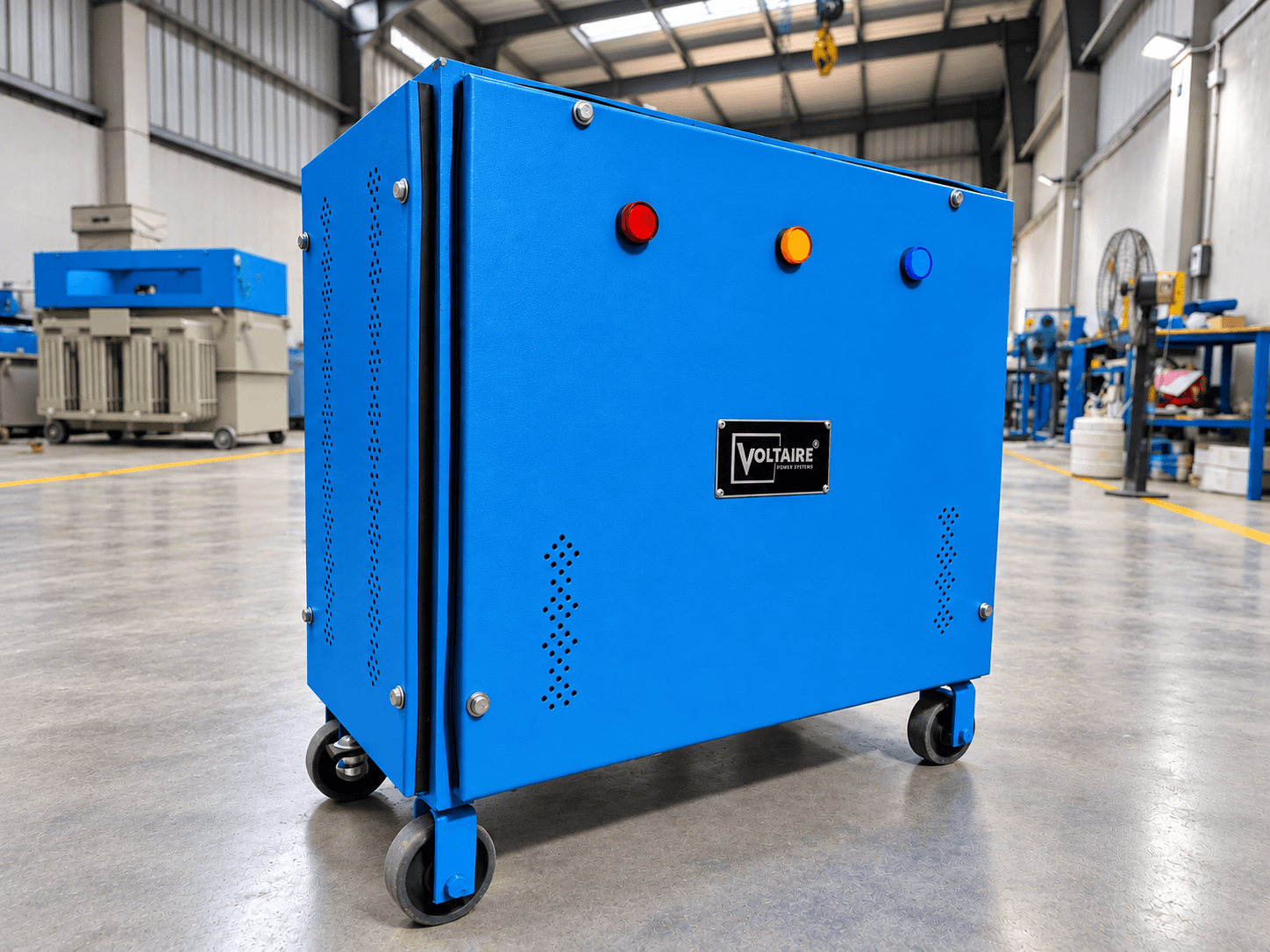
Three-phase isolation transformers installed at the distribution board — isolating a machine, a line, or an entire area, with a clean separately derived neutral for everything downstream.
Feeder-level isolation for plant loads.
Configuration, phase balance, and harmonics
A three-phase isolation transformer is a distribution-level device. Rather than protecting one instrument, it establishes a clean, separately derived supply for everything connected downstream of it — a machine, a production line, a laboratory block, a server room. That scope is what makes the specification different from single-phase work: you are designing for a mixed and changing load rather than a known piece of equipment, which means phase balance, harmonic content, and future load growth all enter the calculation in a way they don't at bench level. The most common industrial application is placing one ahead of a group of machines whose control electronics are being disturbed by the electrical environment of the plant around them — typically CNC and VMC machines, PLC-controlled lines, and process instrumentation sharing a facility with large drives and welding loads.
Three-phase isolation transformers are built in delta-star, delta-delta, or star-star configurations depending on what the installation needs. The choice is not cosmetic: a delta-star arrangement gives a secondary neutral where the primary has none, which is frequently the actual reason the transformer is being installed. A delta primary also provides a circulating path for triplen harmonics, keeping them out of the supply — a meaningful benefit in plants with substantial non-linear load. We build delta-star as standard, with delta-delta and star-star available to order once we know your earthing requirement.
Phase balance matters more here than most specifiers expect. A three-phase transformer feeding significantly unbalanced single-phase loads develops neutral current and uneven winding heating, and its performance degrades from the nameplate figures. If the downstream load is known to be unbalanced, that needs to be stated at the sizing stage rather than discovered afterwards.
Harmonic loading is the other sizing factor. Where the downstream load is heavily non-linear — variable frequency drives, switch-mode supplies, rectifier loads, LED lighting at scale — the harmonic current produces eddy-current and stray losses that heat the transformer beyond what its RMS current would suggest. The transformer must be derated or specified with an appropriate K-factor rating. A unit sized purely on connected kVA in a drive-heavy plant will run hot and age prematurely.
Three-phase vs single-phase
Mostly determined by supply and load scale, but the distinction in *where* each sits in the installation is the practical difference.
| Three Phase | Single Phase | |
|---|---|---|
| Typical installation point | Distribution board — isolates a feeder or area | At the equipment — bench, panel, single device |
| Typical capacity band | Higher — facility and machine-group scale | Lower — instrument and equipment scale |
| Winding configurations | Delta-star, delta-delta, star-star | Single primary, single secondary |
| Phase balance | A design consideration — unbalanced load affects performance | Not applicable |
| Triplen harmonic handling | Delta primary provides a circulating path | Not applicable |
| Scope of protection | Everything downstream | The connected equipment only |
One design note that catches people out: isolating a whole feeder means every load downstream shares one earth reference. That solves the loop between the isolated group and the rest of the plant, but does not solve loops *within* the group. If two connected machines behind the same isolation transformer are still exchanging earth current, that pair needs addressing separately.
What we build
Three-phase isolation transformers are manufactured at our Hapur facility in both standard and ultra-isolation grades, wound and load-tested on site — a 20 kVA standard unit and a 50 kVA ultra-isolation unit are in regular production today. Delta-star is our standard winding configuration, with delta-delta or star-star available to order. K-rated construction is available on request for plants with heavy VFD or SMPS loading — tell us the non-linear proportion of your load and we'll confirm the right K-factor rather than leave it to guesswork.
- Phase
- Three phase
- Configurations
- Delta-star standard; delta-delta and star-star to order
- Grades available
- Standard and ultra-isolation
- K-rating
- Available to order, sized to your harmonic load
- Testing
- Load tested on site, NABL-accredited laboratory
- Compliance
- ISO 9001:2015 · CE marked
Capacity range
Our three-phase range spans a 20 kVA standard unit and a 50 kVA ultra-isolation unit in regular production, within our overall 1 kVA – 500 kVA manufacturing band. For larger feeder-level requirements and custom configurations, send the load schedule and single-line diagram and we'll confirm sizing, configuration, and lead time.
Other isolation transformer types
Three Phase isolation transformer FAQs
Not on connected kVA alone. Drives are non-linear loads whose harmonic current heats the transformer beyond what RMS current predicts, so the unit needs derating or an appropriate K-factor rating. Give us the drive count and ratings along with the rest of the load schedule and we'll size against the actual harmonic profile.
Three Phase isolation — related engineering reading
Background reading on power quality, earthing and voltage stability from our engineering team, including the sizing and compliance issues that come up alongside isolation.
Three-Phase vs Single-Phase Servo Stabilizer — The Industrial Buyer's Complete Guide
Most industrial facilities need a three-phase stabilizer. Some need a single-phase unit. A few need both. Getting this wrong means either buying equipment that doesn't protect what you think it does, or paying for capacity you don't need. Here is exactly how to decide. Author *
Read the guideWhy Our Factory's Machines Kept Tripping — And What a 500 kVA Servo Stabilizer Fixed
A large manufacturing facility was experiencing machine trips across multiple production lines — every day, across both shifts. The drives were checked. The machines were serviced. The problem came back every time. The cause was the power supply. Here is the full story of what we found, what we built, and what changed after installation.
Read the guideWhy Pharmaceutical Plants Cannot Afford Voltage Fluctuation
A single voltage event in a pharmaceutical facility does not just trip a machine — it can corrupt an entire batch, trigger a regulatory audit and cost lakhs in rework. This guide explains exactly why voltage stability is non-negotiable in pharma manufacturing and what facility managers need to do about it.
Read the guideWe size to your load — not to a catalogue rating.
Send your load schedule (and single-line diagram, if you have one) and we'll confirm capacity, configuration, and lead time — with a clear explanation of every design choice.
Speak to an engineer
+91 7060709795[email protected]Direct engineer response within 24 hours.
Submit load requirements