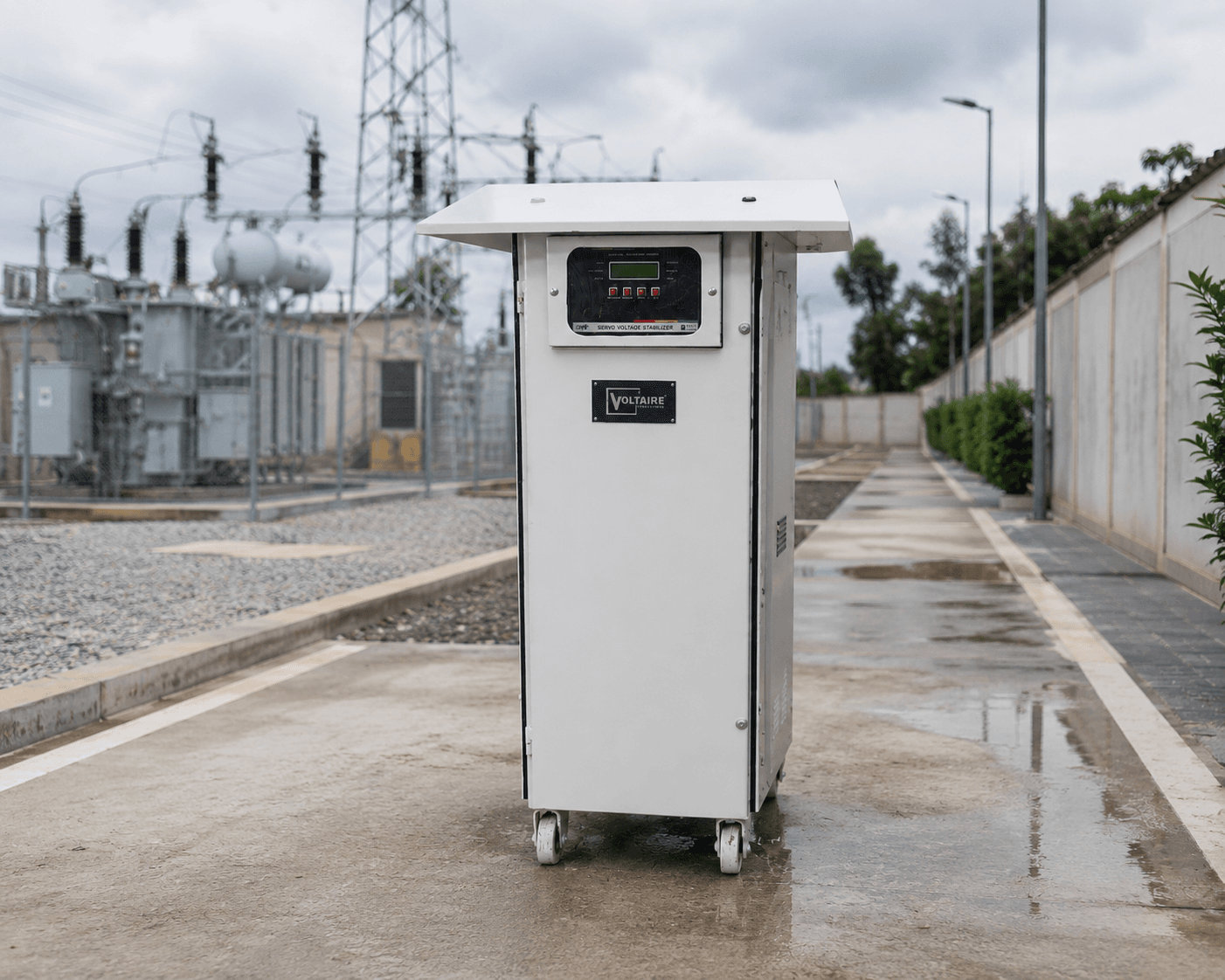
Air Cooled Servo Stabilizer
Air cooled servo stabilizers from 1 kVA to 200 kVA — compact, low maintenance, and correctly specified for Indian factory conditions with adequate airflow and ambient below 40°C.
Air cooling is the right specification for most Indian industrial applications. But only when the ambient, duty cycle, and load profile actually suit it.
Cooling
Air cooled
Capacity
1–200 kVA
Regulation
±1% output
Enclosure
IP21 / IP43
What makes air cooling work — and when it stops working
Air cooled servo stabilizers are the right specification for the majority of Indian industrial applications where the load is moderate, the duty cycle allows for adequate airflow around the unit, and the ambient temperature in the installation location remains below 40°C. They are lighter than oil cooled equivalents, lower in installed cost, easier to transport and install, and require no oil maintenance over their operational life. For the right application, an air cooled unit from Voltaire will run reliably for ten to fifteen years without significant maintenance intervention. The key to getting this performance from an air cooled unit is correct application selection and correct sizing — not simply buying any air cooled unit at the nominal capacity your machines require. An air cooled stabilizer operating continuously at 95% of rated load in a 42°C factory environment will degrade significantly faster than one sized with adequate thermal headroom for those conditions.
In an air cooled servo stabilizer, heat generated in the transformer windings and servo motor during regulation is dissipated by natural convection and forced airflow through ventilation grilles in the enclosure. The design assumes a defined ambient temperature ceiling, sufficient clearance around the unit for air circulation, and a duty cycle that allows the unit to shed heat between heavy-load periods. When these assumptions hold, air cooling is perfectly adequate and has a real cost and maintenance advantage over oil cooled equivalents. When they do not — when ambient climbs above 40°C, when the installation location is enclosed, or when the load is continuous and heavy — the transformer runs hotter than its insulation class rating and degradation accelerates. This is why correct application selection matters more than the nominal kVA rating on the nameplate. Our engineers account for your ambient conditions, duty cycle, and load profile in every air cooled unit we specify.
When to specify air cooled over oil cooled
Cooling choice is an engineering decision based on duty cycle, ambient temperature, and capacity. Here is where each is the correct specification.
Choose air cooled when
- Ambient temperature is consistently below 38°C at the installation location
- Load does not exceed 70% of rated capacity on a continuous basis
- The installation environment has good natural ventilation or air conditioning
- Capacity requirement is below 100 kVA
- Ease of transport, installation, and zero oil-maintenance overhead are important
- The facility is climate-controlled — air-conditioned equipment rooms, hospitals, data centres, labs
Oil cooled is required when
- Continuous duty at or above 70% of rated load
- Ambient temperatures regularly above 40°C
- Enclosed or poorly ventilated installation spaces
- Capacities above 100 kVA, where air-cooled heat dissipation becomes a facility problem
- Outdoor or semi-outdoor sites with dust, moisture, or high heat
We will tell you clearly if your application requires oil cooling — rather than selling you an air cooled unit that will underperform in your conditions.
What Voltaire builds in air cooled
Our air cooled range covers 1 kVA to 200 kVA in single phase and three phase configurations. All units use copper-wound transformers — not aluminium — and industrial-grade servo motors rated for the duty cycles your application requires. Every unit passes full load test before dispatch — output regulation, response time, and temperature rise are verified against rated specifications.
Copper-wound transformers, always
All air cooled units use copper-wound transformer cores. Aluminium winding is a common cost-reduction in the market that reduces continuous-duty performance and shortens winding life.
IP21 and IP43 enclosures
IP21 protection is standard for clean indoor environments. IP43 is available for dusty installations — woodworking, grain processing, cement handling, and similar environments.
Digital metering and monitoring options
Control panels include input and output voltage metering as standard. Digital metering, data logging, and remote monitoring interfaces are available for applications requiring power quality records.
Full load tested before dispatch
Output regulation, response time, and temperature rise are verified under rated load conditions. NABL test certificate and IS 9815 compliance documentation are supplied with every unit.
Key advantages
Typical applications
Technical specifications
Full technical specifications, dimensional drawings, and installation requirements are in the datasheet. Request it directly and we will include a customised specification for your application.
Download datasheet- Capacity Range
- 1 kVA – 200 kVA
- Phases
- Single phase and three phase
- Input Range (1-phase)
- As per Observed Value
- Input Range (3-phase)
- As per Observed Value
- Output Voltage
- 230 V ±1% / 415 V ±1%
- Response Time
- Under 20 milliseconds
- Efficiency
- Above 97% at full load
- Enclosure
- IP21 standard; IP43 available
- Certifications
- IS 9815, ISO 9001:2015, NABL tested
Air Cooled servo stabilizer — engineering guides
Longer-form technical reading on selection, cooling, phase configuration and compliance, written by the engineers who build and commission these units.
Oil Cooled vs Air Cooled Servo Stabilizer — Which One Does Your Factory Actually Need?
Most factories get this choice wrong — and end up with a stabilizer that underperforms or fails early. Oil cooled and air cooled servo stabilizers are not interchangeable. Here is exactly when to specify each, and what happens when you get it wrong.
Read the guideHow to Choose the Right Servo Stabilizer for Your Industry
Choosing the wrong servo stabilizer costs more than buying none at all. This practical guide walks you through every factor — KVA rating, voltage correction range, cooling type, phase selection and more — so you buy exactly what your facility needs.
Read the guideWhat is a Servo Stabilizer? Everything You Need to Know
Voltage fluctuation silently damages equipment across factories, hospitals and homes every day. This guide explains exactly what a servo stabilizer is, how it works, and why industries across India depend on it to protect their equipment and reduce downtime.
Read the guideWe size to your load — not to a catalogue rating.
Correct sizing requires assessing your load profile, ambient conditions, duty cycle, and installation environment. Send us your application details and we will provide a complete specification with a clear explanation of every design choice.
Speak to an engineer
+91 7060709795[email protected]Direct engineer response within 24 hours.
Submit load requirements