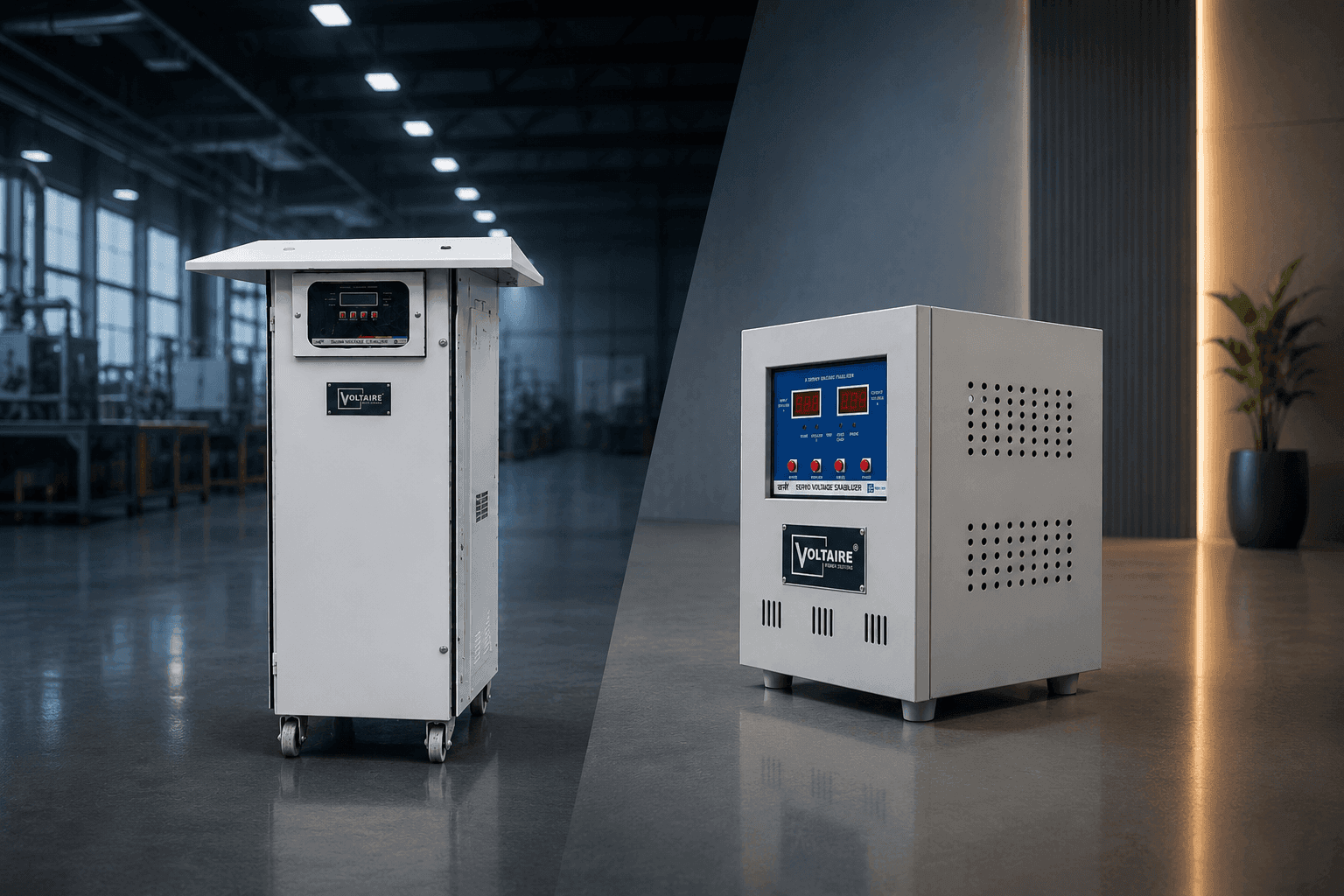
Most industrial facilities need a three-phase stabilizer. Some need a single-phase unit. A few need both. Getting this wrong means either buying equipment that doesn't protect what you think it does, or paying for capacity you don't need. Here is exactly how to decide. Author *
Why This Decision Matters More Than the kVA Rating
When most buyers think about selecting a servo stabilizer, the first question they ask is: what kVA do I need? That is the right question. But the question before it — three-phase or single-phase — is actually more fundamental, because getting it wrong means the unit you buy cannot protect the equipment you are trying to protect, regardless of how correctly you sized the kVA.
A three-phase stabilizer and a single-phase stabilizer are not the same product at different scales. They are fundamentally different pieces of equipment designed for fundamentally different electrical configurations. Understanding the difference, and knowing which one your application requires, is the starting point for any servo stabilizer purchase in an industrial context.
This guide covers the technical difference between the two configurations, the applications where each is correct, the specific scenarios where both are needed simultaneously, and the questions you should ask before specifying either.
The Technical Difference — What Each Configuration Actually Does
Single-phase servo stabilizer
A single-phase stabilizer regulates one phase of electrical supply — the live and neutral conductors that provide 230V AC in India. Inside the unit, a servo motor adjusts a variable autotransformer (variac) to maintain constant output voltage regardless of input variation. Single-phase stabilizers are built for loads connected to single-phase supply — which in an industrial context includes precision instruments, laboratory equipment, computers and control systems, medical diagnostic equipment, small motors running on single-phase supply, and lighting circuits.
Three-phase servo stabilizer
A three-phase stabilizer simultaneously regulates three phases of electrical supply — the R, Y, and B phases that together provide 415V AC between any two phases in India. Industrial machinery — motors, drives, compressors, CNC machines, hydraulic systems — runs on three-phase supply because the three-phase configuration provides higher power density, more efficient motor operation, and balanced loading across the distribution network.
The critical distinction: common control vs independent phase control
Within three-phase stabilizers, there are two design approaches. Common-control units measure the average of the three phases and apply a single correction to all three simultaneously. Independent-phase-control units measure each phase separately and apply independent corrections per phase. For applications where phase-to-phase imbalance is a significant part of the voltage quality problem — which is most Indian industrial estates — independent phase control is the correct specification. Common-control units can maintain correct average voltage while individual phases remain outside specification.
When to Specify Single Phase
Specify a single-phase servo stabilizer when the equipment you are protecting runs exclusively on single-phase 230V supply. In an industrial or commercial context, this includes:
Precision instruments and laboratory equipment. Analytical balances, spectrophotometers, oscilloscopes, calibration equipment, and measurement instruments all run on single-phase supply and have tight input voltage tolerance requirements. Single-phase servo regulation directly at the instrument is often the correct solution — even in facilities that also have three-phase regulation at the building level.
Medical diagnostic equipment. X-ray machines, ultrasound systems, ECG equipment, and patient monitoring systems run on single-phase supply. For these applications, individual single-phase stabilizers dedicated to each piece of equipment provide the most direct and reliable protection — even when the facility also has broader power regulation infrastructure.
Office and commercial loads. Computers, servers in small IT setups, UPS systems, and communication equipment all run on single-phase. In an office building or commercial facility without significant three-phase equipment, a single-phase stabilizer covering the main distribution board is the appropriate solution.
Small single-phase motors. Equipment running on single-phase motors — small pumps, fans, light machinery — can be protected with single-phase units. However, if these machines are part of a larger facility with significant three-phase equipment, a three-phase stabilizer covering the entire facility is usually more cost-effective than individual single-phase units per machine.
When to Specify Three Phase
Specify a three-phase servo stabilizer when your facility has any significant three-phase electrical load. In practice, this means almost every industrial manufacturing operation requires a three-phase stabilizer.
CNC machines, VMCs, and machine tools. CNC machining centres, turning centres, and grinding machines all run on three-phase supply. The spindle drive, servo axis drives, and auxiliary systems are all three-phase loads. A single-phase stabilizer cannot protect these machines — it does not see or regulate the three-phase supply that the drives operate on.
Industrial motors. Any motor above approximately 1.5 kW is almost certainly a three-phase motor. Compressors, hydraulic power packs, conveyor drives, pumps above small capacity, fans above small capacity, mixers, grinders — all three-phase. A facility running these loads needs three-phase regulation.
Packaging and processing machinery. Blister packaging machines, filling lines, extrusion machines, injection moulding machines, textile spinning frames, and most automated production equipment are designed for three-phase supply.
Building-level regulation. When the goal is to protect all equipment in a facility from the main incoming supply — rather than protecting individual machines — a three-phase stabilizer at the incoming distribution panel provides regulation to all three-phase and single-phase circuits simultaneously, since single-phase circuits in an Indian industrial facility are derived from the three-phase distribution system.
When You Need Both — And How to Configure It
Some facilities need both configurations simultaneously — not because a single unit cannot cover the full load, but because different parts of the facility have different protection requirements.
The most common scenario: A manufacturing plant installs a three-phase stabilizer at the main incoming panel, providing regulated three-phase supply to all production equipment. Within the same facility, a laboratory, quality control room, or metrology area has precision measurement instruments that require tighter voltage regulation than the main stabilizer provides — typically ±0.5% rather than ±1%. Dedicated single-phase stabilizers for these areas, fed from the regulated three-phase supply, provide the additional regulation layer the sensitive instruments require.
The second common scenario: A CNC workshop installs a three-phase stabilizer for its machining centres. The CAD workstations, server, and office equipment run on single-phase from a separate distribution circuit that was not included in the three-phase stabilizer's coverage. A single-phase unit on the office distribution panel completes the protection for the entire facility.
How to think about it: Start with your largest and most critical loads — these are almost always three-phase. Size and specify a three-phase stabilizer to cover them. Then identify any remaining single-phase loads with high sensitivity requirements that are not covered by the three-phase unit's output. Add single-phase units for those specific circuits as needed.
We help you map this during the inquiry process — tell us your full facility load and we will recommend the most efficient configuration.
The Decision in Plain Terms
| Your Situation | What You Need | |---|---| | Any CNC, VMC, or machine tool | Three-phase | | Industrial motors above 1.5 kW | Three-phase | | Packaging or processing machinery | Three-phase | | Full facility incoming supply regulation | Three-phase | | Laboratory instruments only | Single-phase | | Medical diagnostic equipment | Single-phase | | Office and computer loads only | Single-phase | | CNC workshop + separate precision lab | Three-phase + single-phase | | Not sure what your machines run on | Call us — we'll tell you in 5 minutes |
The simplest rule: if any motor in your facility is above 1.5 kW, you need a three-phase stabilizer. Single-phase units are for precision electronics, instruments, and light loads — not for the motor-driven machinery that defines most industrial operations.
When you inquire with us, tell us your machine list — motor ratings, drive types, whether your supply is single or three-phase at the main panel. We will confirm the correct configuration before we quote anything.
Call: +91 7060709795 Email: [email protected] Engineer response within 24 hours. We confirm the right specification before we discuss price.
Key Terms
Important Points
Core lessons & insights
Any motor above 1.5 kW is three-phase — that facility needs a three-phase stabilizer
Single-phase stabilizers protect instruments, computers, and light equipment — not industrial motors or drives
Independent phase control corrects each phase separately — essential when phase imbalance is part of the problem
Some facilities need both — three-phase for production, single-phase for labs or precision areas
Getting phase configuration wrong means the stabilizer cannot protect the equipment regardless of kVA rating
Did this help?
August 20, 2026
Written by
Voltaire Engineering Team
Voltaire Power Systems LLP — OEM manufacturer since 1990
Our credentials & manufacturing facility →