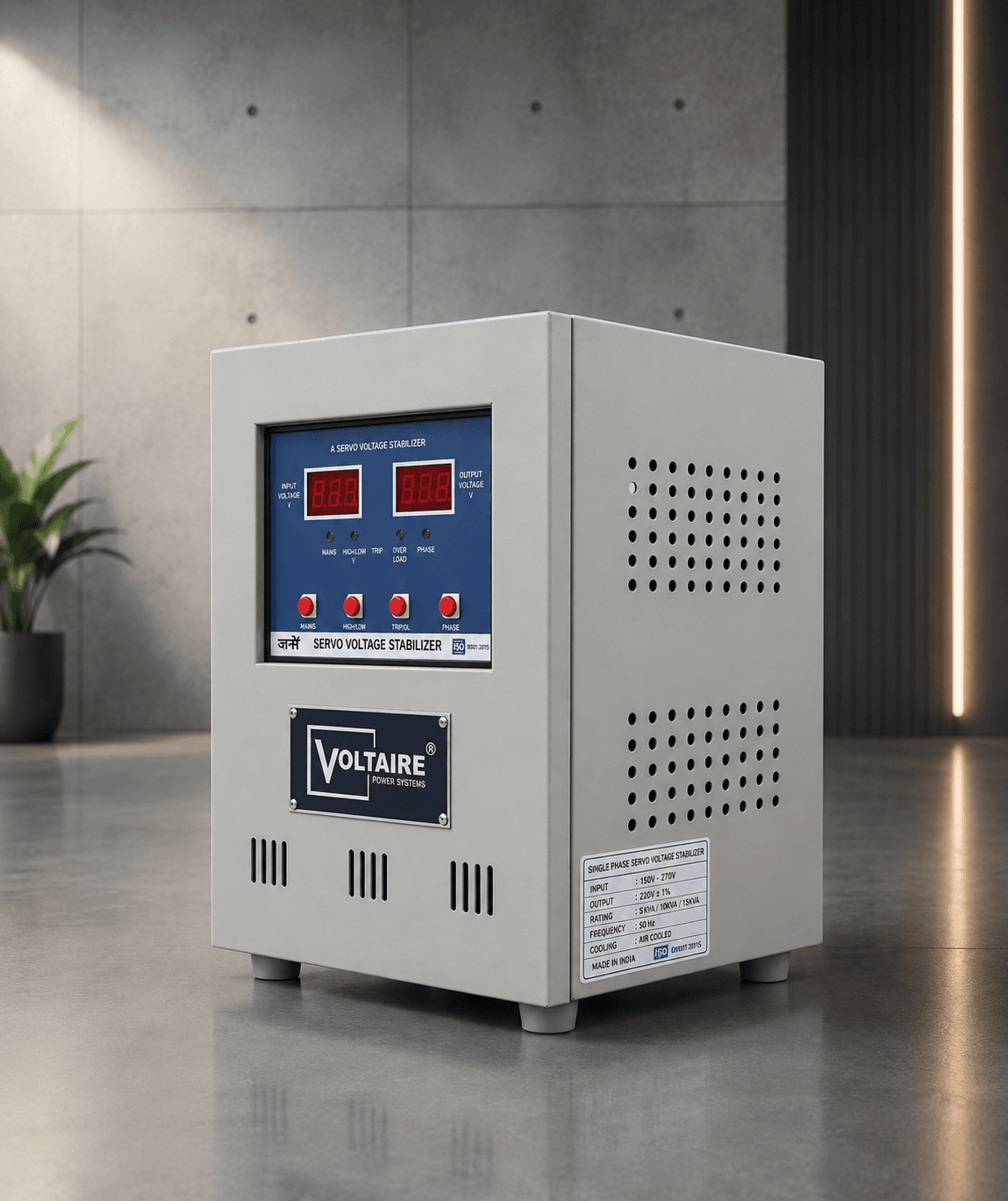
Single Phase Servo Stabilizer
Single phase servo voltage stabilizers from 1 kVA to 50 kVA — continuous, stepless regulation for industrial instruments, medical equipment, and sensitive electronics.
Relay-based correction creates voltage steps. Servo correction is continuous and invisible to even the most sensitive electronic load.
Capacity
1–50 kVA
Regulation
230V ±1%
Correction
Stepless servo
Response
<20 ms
Servo correction vs relay-based correction
Single phase servo voltage stabilizers protect equipment connected to single-phase supply — which in an industrial context includes precision instruments, analytical equipment, laboratory apparatus, sensitive electronic control systems, medical diagnostic equipment, office and commercial electrical loads, and small to medium machinery running on single-phase power. The same voltage problems that affect three-phase industrial equipment — sags, spikes, chronic undervoltage, overvoltage — affect single-phase equipment with equal severity, and often with more visible consequences because single-phase loads typically include more sensitive electronics than heavy three-phase motor loads. A single-phase servo stabilizer is fundamentally different from a relay-based stabilizer or a static stabilizer in how it regulates voltage. The servo mechanism provides continuous, stepless voltage correction — not switched correction in discrete steps. This means the output voltage tracks continuously to the set point rather than jumping between steps as the input varies.
For sensitive electronics, the difference between servo and relay-based correction is significant. Relay-based correction creates voltage steps that some equipment registers as micro-disturbances — the output does not change smoothly but switches between fixed tap positions, creating a transient each time a tap change occurs. Servo correction is continuous: the variac wiper moves proportionally to the measured deviation, and the output tracks the set point without steps or switching transients. This is invisible to even the most sensitive electronic load. All Voltaire single phase units use copper-wound variacs and precision servo motors with response times under 20 milliseconds. Output regulation is ±1% — matching our three-phase industrial range, not the ±3% common in cheaper single-phase stabilizers. Every unit is load-tested before dispatch and supplied with NABL test certificate and IS 9815 compliance documentation.
Industrial servo vs domestic relay-based stabilizers
This distinction matters in procurement. Industrial and medical applications require a different product category — not just a higher-rated domestic unit.
Industrial servo stabilizer (IS 9815)
- Continuous stepless correction — no switching transients, invisible to sensitive electronics
- ±1% regulation accuracy — matches what precision instruments and medical equipment require
- Built for continuous industrial duty — not cyclic domestic use
- IS 9815 compliant with NABL test documentation
- Copper-wound variac and industrial servo motor rated for your duty cycle
- Suitable for medical diagnostic equipment, laboratory instruments, CNC control panels
Domestic relay-based stabilizer
- Step correction — output jumps between tap positions, creating switching transients
- ±5% to ±8% typical regulation accuracy
- Designed for home appliances — AC units, refrigerators, TVs — not continuous industrial duty
- Not IS 9815 compliant regardless of the kVA rating on the label
- Not suitable for medical, laboratory, or precision industrial applications
If your equipment is in an industrial, commercial, or medical context, specify IS 9815-compliant servo stabilizers — not appliance-grade stabilizers regardless of kVA rating.
What Voltaire builds in single phase
Voltaire manufactures single phase servo voltage stabilizers from 1 kVA to 50 kVA. The 1 kVA to 10 kVA range covers individual equipment protection for instruments, computers, medical equipment, and small machines. The 10 kVA to 50 kVA range covers larger single-phase loads including X-ray equipment, laboratory autoclaves, welding machines, and lighting systems. Custom capacity and custom output voltage requirements are available on request.
1 kVA to 10 kVA — individual equipment protection
Instruments, computers, medical diagnostic equipment, analytical apparatus, and small machinery on dedicated single-phase circuits. Built to IS 9815 industrial specification with ±1% regulation.
10 kVA to 50 kVA — larger single-phase loads
X-ray equipment, laboratory autoclaves, industrial welding machines, and large lighting systems. Same copper-wound variac construction and servo motor quality as the smaller range.
Custom output voltages available
We frequently build units with non-standard output voltages for export-specification equipment and legacy industrial machines that require voltages other than 230V standard.
NABL test certificate supplied
Every unit is load-tested before dispatch and supplied with NABL test certificate. IS 9815 compliance documentation is included. No exceptions for medical or laboratory procurement requirements.
Key advantages
Typical applications
Technical specifications
Full technical specifications, dimensional drawings, and installation requirements are in the datasheet. Request it directly and we will include a customised specification for your application.
Download datasheet- Capacity Range
- 1 kVA – 50 kVA
- Phases
- Single phase
- Input Voltage Range
- 160 V – 270 V (standard); custom ranges available
- Output Voltage
- 230 V ±1% (standard); custom voltages available
- Response Time
- Under 20 milliseconds
- Waveform Distortion
- Nil
- Efficiency
- Above 97% at full load
- Certifications
- IS 9815, ISO 9001:2015, NABL tested
Single Phase servo stabilizer — engineering guides
Longer-form technical reading on selection, cooling, phase configuration and compliance, written by the engineers who build and commission these units.
Three-Phase vs Single-Phase Servo Stabilizer — The Industrial Buyer's Complete Guide
Most industrial facilities need a three-phase stabilizer. Some need a single-phase unit. A few need both. Getting this wrong means either buying equipment that doesn't protect what you think it does, or paying for capacity you don't need. Here is exactly how to decide. Author *
Read the guideHow to Choose the Right Servo Stabilizer for Your Industry
Choosing the wrong servo stabilizer costs more than buying none at all. This practical guide walks you through every factor — KVA rating, voltage correction range, cooling type, phase selection and more — so you buy exactly what your facility needs.
Read the guideWhat is a Servo Stabilizer? Everything You Need to Know
Voltage fluctuation silently damages equipment across factories, hospitals and homes every day. This guide explains exactly what a servo stabilizer is, how it works, and why industries across India depend on it to protect their equipment and reduce downtime.
Read the guideWe size to your load — not to a catalogue rating.
Correct sizing requires assessing your load profile, ambient conditions, duty cycle, and installation environment. Send us your application details and we will provide a complete specification with a clear explanation of every design choice.
Speak to an engineer
+91 7060709795[email protected]Tell us your equipment and we'll specify the correct unit. Engineer response within 24 hours.
Submit load requirements