Three Phase Servo Stabilizer
Three phase servo stabilizers with independent per-phase control for industrial facilities — 10 kVA to 2000 kVA, ±1% regulation on each individual phase.
Phase imbalance is as damaging as voltage variation. Independent phase control corrects each phase independently — not as an averaged compromise.
Capacity
10–2000 kVA
Phase Control
Independent
Regulation
415V ±1%
Response
<20 ms
Independent phase control — why it matters
Industrial facilities in India operate on three-phase power supply — and the problems they face with that supply are three-phase problems. Voltage variation in an industrial estate is not uniform across all three phases simultaneously. Phase R may be running at 390V while Phase Y is at 415V and Phase B is at 430V. This phase imbalance is as damaging to three-phase motors, drives, and control systems as overall voltage variation — and it is a problem that a three-phase stabilizer without independent phase control cannot fix. A conventional three-phase stabilizer measures and regulates the average of the three phases. If one phase is significantly lower than the others, the common control system averages it out and the correction applied is a compromise — not the exact correction each phase needs independently.
Voltaire three-phase servo stabilizers use an independent servo motor and control circuit for each phase — meaning Phase R, Phase Y, and Phase B are each regulated independently based on their individual voltage deviation from the set point. When Phase R drops due to a large load connecting to that phase, the Phase R servo corrects independently and immediately — without affecting the regulation of Phase Y or Phase B, and without waiting for the other phases to drive an averaged correction. The practical consequence is better regulation accuracy — typically ±1% on each individual phase rather than ±1% on the average — and faster response to single-phase disturbances, which are the most common voltage events in Indian industrial distribution networks. For three-phase motor loads, balanced phase voltage is as important as correct voltage magnitude. Unbalanced phase voltage causes negative sequence currents in motor windings that produce heat without producing useful work, degrading insulation and shortening motor life.
When to specify three-phase over single-phase units
The phase configuration depends on your load architecture. Here is where each is the correct specification.
Choose three-phase when
- Your facility runs three-phase electrical loads — motors, drives, CNC machines, compressors
- You have observed phase imbalance or single-phase voltage events on your distribution network
- Your loads include large induction motors where negative-sequence heating is a concern
- You need a single stabilizer protecting an entire feeder or sub-distribution board
- Mixed loads exist and a tap-off provision can serve both three-phase and single-phase equipment
Single-phase units are appropriate when
- Protecting individual equipment on single-phase supply
- Laboratory, medical, or office equipment on dedicated single-phase circuits
- As supplementary protection for high-value machines in already-stabilized facilities
For facilities with mixed single-phase and three-phase loads, we build three-phase stabilizers with single-phase tap-off provisions — providing regulated output for all load types from a single unit.
What Voltaire builds in three-phase
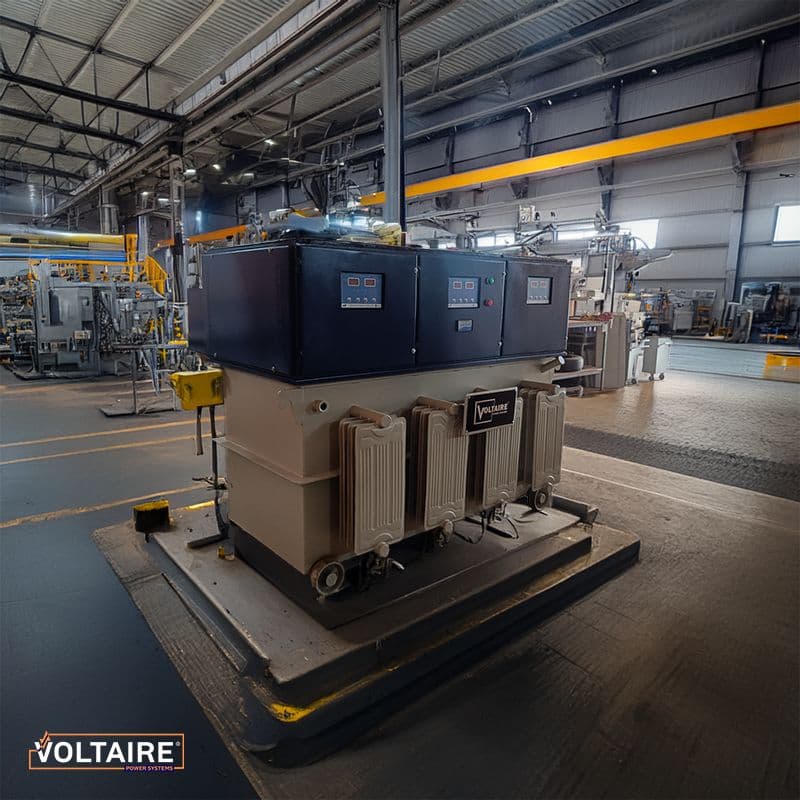
We manufacture three-phase servo stabilizers from 10 kVA to 2000 kVA with independent phase control as standard. Cooling options are air cooled for standard-duty applications up to 100 kVA in good airflow conditions, and oil cooled for continuous-duty applications above 100 kVA or any application in high-ambient-temperature environments.
Independent per-phase servo control
Each phase has its own servo motor and control circuit. Phase R, Y, and B are corrected simultaneously but independently — not as an averaged three-phase correction.
±1% per phase, not on average
Output regulation is ±1% on each individual phase. This is the critical difference from common-control three-phase designs that may show ±1% average while individual phases remain off specification.
Single-phase tap-off available
For facilities with mixed loads, three-phase units are available with single-phase tap-off provisions to supply regulated single-phase output for lighting, computers, and control systems.
Custom input ranges
Standard input is 300V–470V three-phase. Custom input windows are available for sites with unusually wide grid variation or non-standard supply voltages.
Key advantages
Typical applications
Technical specifications
Full technical specifications, dimensional drawings, and installation requirements are in the datasheet. Request it directly and we will include a customised specification for your application.
Download datasheet- Capacity Range
- 10 kVA – 2000 kVA
- Phases
- Three phase
- Phase Control
- Independent per phase
- Input Voltage Range
- 300 V – 470 V (3-phase); custom ranges available
- Output Voltage
- 415 V ±1% per phase
- Response Time
- Under 20 milliseconds
- Efficiency
- Above 98% at full load
- Cooling
- Air cooled (≤100 kVA) / Oil cooled (>100 kVA or continuous duty)
- Certifications
- IS 9815, ISO 9001:2015, NABL tested, CE marked
Three Phase servo stabilizer — engineering guides
Longer-form technical reading on selection, cooling, phase configuration and compliance, written by the engineers who build and commission these units.
Three-Phase vs Single-Phase Servo Stabilizer — The Industrial Buyer's Complete Guide
Most industrial facilities need a three-phase stabilizer. Some need a single-phase unit. A few need both. Getting this wrong means either buying equipment that doesn't protect what you think it does, or paying for capacity you don't need. Here is exactly how to decide. Author *
Read the guideWhy Our Factory's Machines Kept Tripping — And What a 500 kVA Servo Stabilizer Fixed
A large manufacturing facility was experiencing machine trips across multiple production lines — every day, across both shifts. The drives were checked. The machines were serviced. The problem came back every time. The cause was the power supply. Here is the full story of what we found, what we built, and what changed after installation.
Read the guideHow to Choose the Right Servo Stabilizer for Your Industry
Choosing the wrong servo stabilizer costs more than buying none at all. This practical guide walks you through every factor — KVA rating, voltage correction range, cooling type, phase selection and more — so you buy exactly what your facility needs.
Read the guideWe size to your load — not to a catalogue rating.
Correct sizing requires assessing your load profile, ambient conditions, duty cycle, and installation environment. Send us your application details and we will provide a complete specification with a clear explanation of every design choice.
Speak to an engineer
+91 7060709795[email protected]Direct engineer response within 24 hours.
Submit load requirements