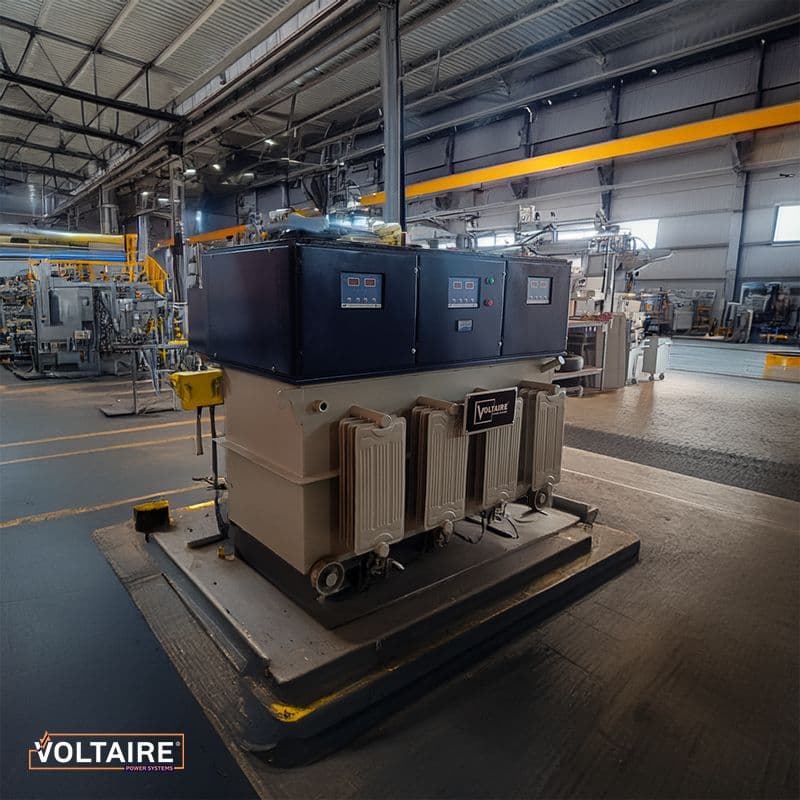
Choosing the wrong servo stabilizer costs more than buying none at all. This practical guide walks you through every factor — KVA rating, voltage correction range, cooling type, phase selection and more — so you buy exactly what your facility needs.
Introduction
Buying a servo stabilizer is not a simple catalogue selection. Choose one that is undersized and it will overheat and fail under load. Choose one with the wrong correction range and it will not protect your equipment during the voltage dips that matter most.
This guide gives you a step-by-step framework to select the right servo stabilizer for your application — whether you are a plant manager specifying for a production line, an EPC consultant preparing a BOQ, or a procurement head evaluating vendors.
Step 1 — Determine Your Load
The first and most important step is calculating your total connected load.
For a single machine or equipment:
KVA = (Voltage × Current) ÷ 1000
For a facility or production line:
Add up the KW rating of all equipment connected to the stabilizer Divide by the average power factor (typically 0.8 for mixed industrial loads) This gives you the minimum KVA requirement
Always add a 20–25% safety margin to account for:
- Starting current surges (motors draw 3–6x rated current at startup)
- Future load additions
- Derating in high ambient temperature environments
Example:
A textile plant with 40 KW of connected motors and a power factor of 0.8:
40 ÷ 0.8 = 50 KVA minimum With 25% margin = 65 KVA recommended
Step 2 — Measure Your Incoming Voltage Range
This is the step most buyers skip — and it is the most critical.
Your servo stabilizer must be able to correct the full range of voltage your site actually experiences. If your incoming voltage dips to 300V during peak hours but your stabilizer is only rated to correct from 320V, it will fail to protect your equipment exactly when you need it most.
How to measure:
- Use a data logger or digital voltmeter across all three phases
- Record readings across a full working day — morning, afternoon and peak evening hours
- Note the minimum voltage recorded and the maximum voltage recorded
Standard correction ranges available:
- 300V – 470V input → 415V output (most common for industrial India)
- 320V – 460V input → 415V output (tighter range, more efficient)
- 160V – 270V input → 230V output (single phase residential/commercial)
Always specify a correction range that comfortably covers your actual minimum and maximum — not just the nominal.
Step 3 — Choose Single Phase or Three Phase
Single phase stabilizers are for 230V supply — homes, shops, small offices and light commercial setups running appliances, computers and small equipment.
Three phase stabilizers are for 415V supply — factories, industrial plants and large commercial facilities running motors, compressors, CNC machines and production lines. KVA ranges typically start from 10 KVA and go up to several MVA.
For three phase installations you also need to decide between two configurations:
Balanced three phase uses a single servo motor to correct all three phases together. This is simpler, lower cost, and suitable for most industrial applications where the load is reasonably balanced across all three phases.
Independent three phase uses a separate servo correction mechanism per phase. This is recommended for facilities with heavily unbalanced loads — where one phase consistently carries significantly more load than the others.
If you are unsure which applies to your facility, a simple current measurement across all three phases during peak operation will tell you. If the difference between phases is more than 10–15%, independent phase correction is worth specifying.
Step 4 — Select Cooling Type
Air Cooled
- Suitable for: Up to 30–50 KVA typically
- Environment: Indoor, well-ventilated spaces
- Advantage: Lower cost, easier maintenance, no oil handling
- Limitation: Less efficient in high ambient temperatures or dusty environments
Oil Cooled
- Suitable for: 50 KVA and above (can go to several MVA)
- Environment: Industrial, outdoor or high ambient temperature locations
- Advantage: Better thermal stability, handles continuous heavy duty loads, longer operational life
- Limitation: Requires oil level monitoring and periodic maintenance
Rule of thumb:
- Below 50 KVA in a clean, ventilated space → Air cooled
- Above 50 KVA or harsh environment → Oil cooled
Step 5 — Specify the Output Voltage Accuracy
All servo stabilizers are not equally accurate and the difference matters more than most buyers realise.
Standard accuracy of ±3% to ±5% is sufficient for general industrial loads like motors, pumps and basic machinery. If your equipment can tolerate minor voltage variation without affecting performance or output quality, this level is acceptable.
High precision accuracy of ±1% to ±2% is the recommended specification for most serious industrial applications — CNC machines, automated production lines, packaging equipment and commercial facilities.
Ultra precision accuracy of ±0.5% or better is required for pharmaceutical manufacturing, laboratory equipment, medical devices and any application where even a minor voltage deviation affects product quality or equipment integrity.
For the majority of manufacturing plants and industrial facilities in India, ±1% accuracy is the right specification to ask for. If you are running sensitive equipment or operating in pharma or healthcare, always specify ±0.5% or better and ask your vendor to demonstrate it on a load test before dispatch.
Step 6 — Consider Your Installation Environment
The environment where your stabilizer will be installed directly affects which design features you need to specify. This step is skipped by most buyers and is the reason many stabilizers fail long before their rated lifespan.
If your installation is in a dusty environment, an outdoor location, or near material handling equipment, you need an enclosure with an IP54 rating or higher. This protects the internal components from dust ingress and water splashing that would otherwise damage the windings and control circuit over time.
If your facility has high humidity — common in coastal locations or facilities with open water processes — specify tropicalised winding insulation. Standard insulation absorbs moisture over time, which degrades its dielectric strength and eventually causes winding failure.
If your installation environment has a corrosive atmosphere — chemical plants, fertiliser facilities, coastal industrial zones — the enclosure should be epoxy coated or made from stainless steel. Standard painted mild steel enclosures corrode within months in these conditions.
If your site is at high altitude above 1000 metres, air is thinner and cooling efficiency drops. A derating factor needs to be applied to the KVA rating, meaning you need a higher rated unit than the load calculation alone would suggest. Your supplier should calculate this for you.
If space is a constraint, compact designs and wall-mounted configurations are available for smaller KVA ratings. Always share your available floor space and installation dimensions with your supplier before finalising the order.
The simplest way to handle this step correctly is to share your installation details — location, environment type, ambient temperature, available space — with your supplier before any specification is finalised. A reputable manufacturer will factor all of this in before recommending a unit.
Step 7 — Verify Certifications Before You Buy
A servo stabilizer is only as good as the quality of its components and manufacturing process. Before finalising any vendor, verify:
- ISO certification — quality management at every stage of production
- CE marking — compliance with European safety and performance standards
- IEC compliance — adherence to international electrotechnical standards
- RoHS compliance — restriction of hazardous substances in components
- Test reports — ask for the factory test report specific to your unit, not a generic sample report
At Voltaire Power Systems, every unit ships with a full test report covering no-load and full-load testing, input/output voltage readings, and efficiency data.
Common Mistakes to Avoid
1. Buying based on price alone The cheapest servo stabilizer uses inferior components, skips load testing, and fails within 12–18 months. The repair and replacement cost far exceeds any initial saving.
2. Undersizing the KVA Operating a stabilizer above its rated capacity causes overheating, reduced lifespan and eventual failure. Always size with a 20–25% margin.
3. Ignoring the voltage correction range A stabilizer rated for 340V–460V input will not protect equipment when your voltage drops to 300V at peak load hours.
4. Not requesting a site survey Every installation is different. Load distribution, cable length, earthing quality and ambient temperature all affect the final specification. A reputable manufacturer will always conduct or request a site survey before recommending a unit.
5. Buying without after-sales support Your servo stabilizer requires periodic maintenance — brush replacement, oil level checks, calibration. Ensure your vendor has a service network before you sign the purchase order.
Key Terms
Important Points
Core lessons & insights
Always calculate total connected load and add 25% safety margin before specifying KVA
Measure your actual incoming voltage range across a full day — never specify based on nominal voltage alone
Air cooled suits loads below 50 KVA in clean environments; oil cooled is required for larger or harsher installations
Output accuracy of ±1% is the minimum for industrial equipment; specify ±0.5% for sensitive or precision loads
Certifications like ISO, CE and IEC are not optional — they are the only reliable indicator of manufacturing quality
Always request a site survey and full load test report before finalising any purchase
Did this help?
May 9, 2026
Written by
Siddharth
Admin