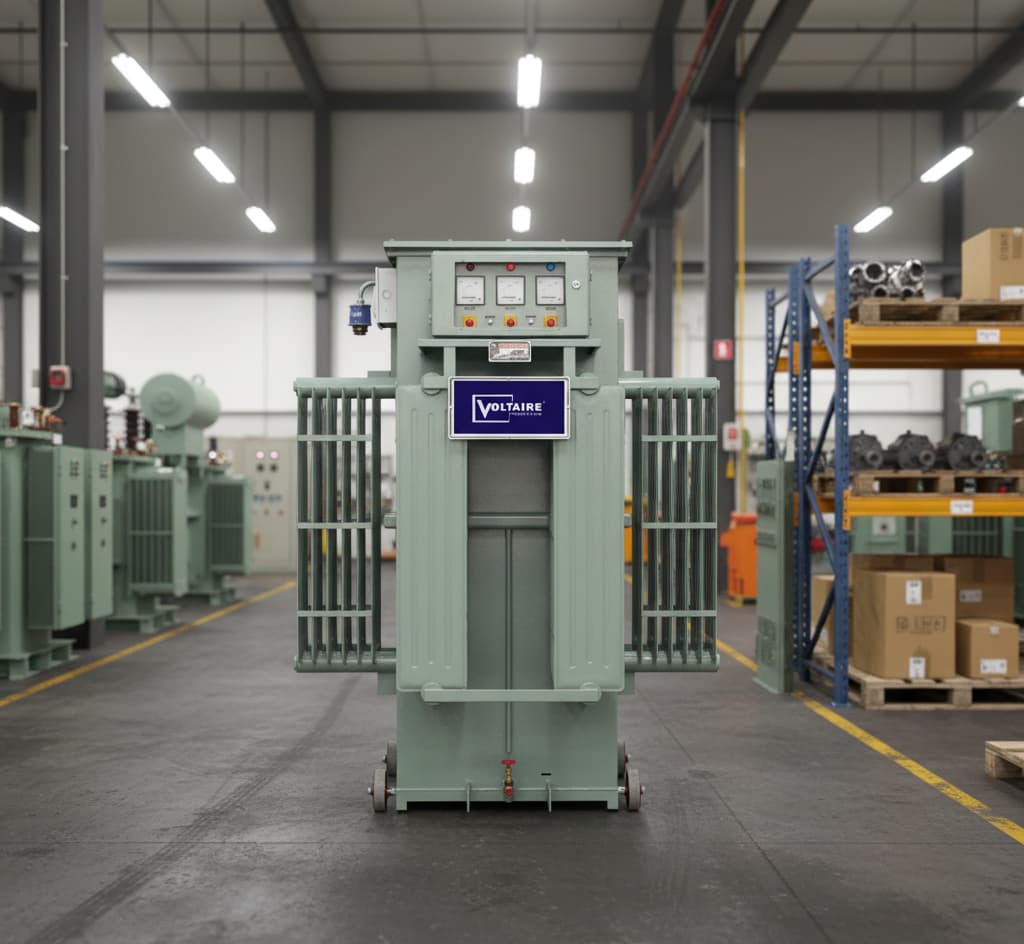
Voltage fluctuation silently damages equipment across factories, hospitals and homes every day. This guide explains exactly what a servo stabilizer is, how it works, and why industries across India depend on it to protect their equipment and reduce downtime.
Introduction
Every electrical appliance and industrial machine is built to operate at a specific voltage. In India, that standard is 230V for single-phase and 415V for three-phase supply. But in reality, the voltage coming from your grid rarely stays at that level.
It rises. It drops. It surges. Sometimes within the same hour.
This is voltage fluctuation — and it is one of the leading causes of equipment failure, energy waste and unplanned downtime across Indian industries.
A servo stabilizer is the device that fixes this problem. It sits between your power supply and your equipment, corrects incoming voltage in real time, and ensures your machines always receive exactly the voltage they were designed to run on.
What is a Servo Stabilizer?
A servo stabilizer is an automatic voltage regulating device that uses a servo motor-driven mechanism to correct incoming voltage fluctuations and deliver a stable, regulated output voltage to connected equipment.
Unlike basic voltage stabilizers that work in steps, a servo stabilizer corrects voltage continuously and precisely — making it suitable for sensitive industrial equipment, medical devices, CNC machines, and large electrical loads.
The word "servo" refers to the servo motor inside the unit, which physically adjusts a variable autotransformer (called a variac or dimmerstat) to raise or lower the output voltage as needed.
How Does a Servo Stabilizer Work?
The working principle of a servo stabilizer can be broken into four steps:
-
Sensing A voltage sensing circuit constantly monitors the incoming supply voltage.
-
**Comparison **The sensed voltage is compared against the desired reference voltage (e.g. 415V for three-phase).
-
Correction Signal If a deviation is detected, the electronic control circuit sends a signal to the servo motor.
-
Adjustment The servo motor rotates the carbon brush of the variac, which adjusts the transformer tap and corrects the output voltage — bringing it back to the set reference level.
This entire process happens within milliseconds, continuously, without any interruption to your equipment.
Types of Servo Stabilizers
By Phase
- Single Phase — For residential, light commercial and small equipment loads
- Three Phase — For industrial machinery, large commercial setups and manufacturing plants
By Cooling Method
- Air Cooled — Suitable for smaller KVA ratings (typically up to 30–50 KVA). Uses fans for heat dissipation. Ideal for indoor, ventilated environments.
- Oil Cooled — Suitable for larger KVA ratings (50 KVA and above). Uses transformer oil for cooling. Better thermal stability for continuous heavy duty operation.
What is the Purpose of a Servo Stabilizer?
The primary purpose of a servo stabilizer is to protect electrical and electronic equipment from damage caused by voltage fluctuation.
But the benefits go further than just protection: 1. Equipment Protection Voltage fluctuation causes insulation breakdown, winding damage in motors, and premature failure of electronic components. A servo stabilizer eliminates this risk entirely.
2. Reduced Downtime Unplanned stoppages caused by voltage-related tripping cost factories hours of production. Stable voltage means machines run without interruption.
3. Extended Equipment Life Machines running at rated voltage experience less thermal stress, less electrical stress, and last significantly longer before requiring repair or replacement.
4. Energy Savings Equipment running on fluctuating voltage draws more current than necessary, increasing energy consumption. Stable voltage means rated current, rated consumption — nothing wasted.
5. Improved Output Quality In industries like textiles, packaging and food processing, voltage instability directly affects the consistency and quality of output. A stable power supply ensures consistent production.
The primary purpose of a servo stabilizer is to protect electrical and electronic equipment from damage caused by voltage fluctuation.
But the benefits go further than just protection:
Where is a Servo Stabilizer Used?
Servo stabilizers are used across virtually every sector where electrical equipment operates on an unstable grid:
- Manufacturing plants — CNC machines, motors, conveyors, compressors
- Pharmaceutical facilities — Reactors, HVAC systems, clean room equipment
- Hospitals & healthcare — Operation theatre equipment, ICU devices, diagnostic machines
- Data centers & IT — Servers, networking equipment, UPS systems
- Textile industry — Looms, spinning machines, dyeing equipment
- Agriculture & cold storage — Water pumps, refrigeration compressors
- Residential & commercial — Air conditioners, lifts, home appliances in areas with poor grid quality
What KVA Rating Do You Need?
KVA (Kilovolt-Ampere) is the unit of apparent power — and choosing the right KVA rating for your servo stabilizer is critical.
A simple rule of thumb:
Total connected load (in KW) ÷ Power Factor = KVA required Add 20–25% margin for safety and future load growth.
For accurate sizing, always conduct a site survey that measures:
- Total connected load
- Incoming voltage range (minimum and maximum)
- Type of equipment (resistive, inductive, or electronic)
- Single phase or three phase requirement
Conclusion
A servo stabilizer is not an optional accessory. For any facility operating industrial equipment, medical devices, or sensitive electronics on an Indian power grid, it is an essential layer of protection.
Voltage fluctuation is invisible — until it causes a failure that costs far more than any stabilizer ever would.
If you are evaluating servo stabilizers for your facility or project, the right starting point is a proper load assessment and site survey. At Voltaire Power Systems, we help you identify the right configuration, KVA rating and cooling method based on your actual requirement.
📞 Contact us for a free load assessment and product recommendation.
Key Terms
Important Points
Core lessons & insights
A servo stabilizer corrects voltage fluctuations continuously in real time using a servo motor mechanism
Unlike relay-based stabilizers, servo stabilizers achieve ±1% correction accuracy making them suitable for sensitive industrial equipment
The benefits go beyond protection — stable voltage reduces energy consumption, extends equipment life and prevents unplanned downtime
Servo stabilizers are available in single and three phase, air cooled and oil cooled variants depending on the load and environment
Correct KVA sizing requires a site survey — oversizing and undersizing both lead to poor performance
Did this help?
May 8, 2026
Written by
Aryan
Admin