Single-Phase Isolation Transformer
Single-phase isolation transformers for equipment-level and point-of-use installation — test benches, analytical instruments, medical devices, and control panels that need their own clean earth reference.
Bench, lab, and instrument-level isolation.
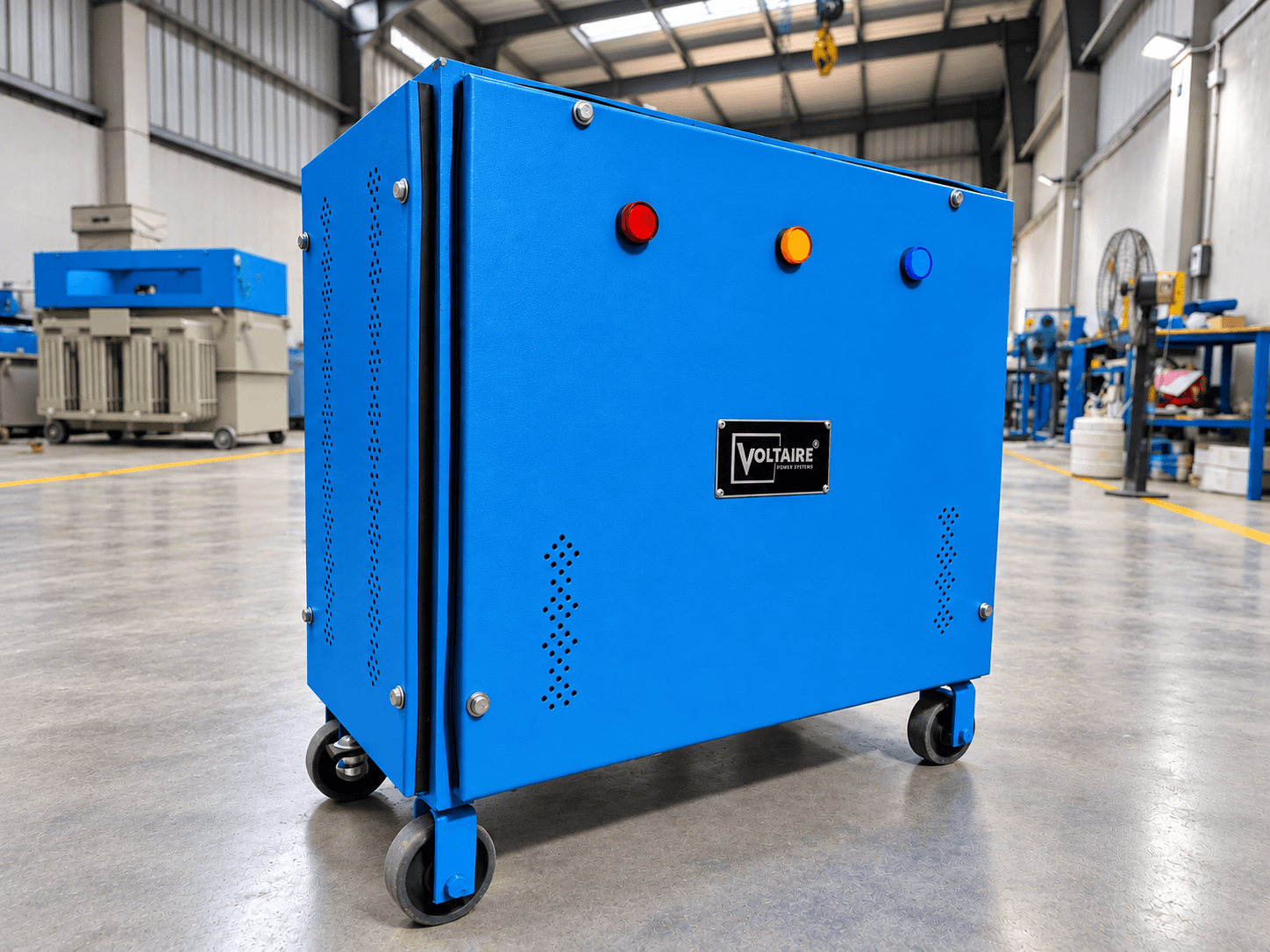
Configuration and what to watch in specification
Single-phase isolation transformers occupy a different position in an electrical installation than their three-phase counterparts. Where a three-phase unit typically sits at a distribution board and isolates a whole feeder, a single-phase unit is usually installed at or near the equipment itself — one instrument, one bench, one control panel, one machine. That placement changes what matters in the specification. Capacities are lower, but the loads are frequently more sensitive and less tolerant of a poor earth reference than a general plant load would be. It also changes the failure mode you're protecting against: a bench-level isolation transformer is often installed as much for operator safety around exposed test circuits as for the equipment's benefit.
The winding arrangement is a straightforward single primary and single secondary at a 1:1 ratio, galvanically separated. The secondary is a separately derived system, so the neutral-to-earth bond is established at the transformer, giving the connected equipment a local earth reference independent of whatever conditions exist on the building's distribution earth.
Sizing single-phase units demands more attention to inrush than the kVA figure suggests. Equipment with switch-mode power supplies, capacitor-input rectifiers, or motor loads draws a starting current well above its steady-state rating, and a transformer sized tightly to the nameplate will suffer voltage dip at every start. The correct approach is to size against the actual load profile including inrush, not against the sum of nameplate ratings — which is the calculation we do for you when you send the load list.
The second consideration is the load's linearity. Instruments, computers, and anything with a switch-mode supply are non-linear loads that draw harmonic current, which produces additional heating in the transformer beyond what the RMS current alone would predict. Under-sizing here shows up not as immediate failure but as a transformer that runs persistently hot and ages early.
Single-phase vs three-phase — choosing the right one
This is usually determined by your supply and your load, not by preference — but there are cases where either would work, and the choice matters.
| Single Phase | Three Phase | |
|---|---|---|
| Typical installation point | At or near the equipment — bench, panel, single machine | At a distribution board, isolating a feeder or an area |
| Typical capacity band | Lower — instrument and equipment scale | Higher — facility and feeder scale |
| Typical loads | Instruments, test benches, medical devices, control panels, IT equipment | Machines, machine groups, motor loads, mixed plant loads |
| Phase balance | Not applicable | A real design consideration — unbalanced loading affects performance |
| Earth reference scope | One equipment item or bench | Everything downstream of the transformer |
Where a single sensitive machine sits on a three-phase supply, both are viable: a three-phase isolation transformer for the machine, or single-phase units on the specific sensitive circuits within it. The three-phase route is simpler and usually correct; the single-phase route can be more economical when only a small part of the machine is actually noise-sensitive.
What we build
Single-phase isolation transformers are built at our Hapur facility in both standard and ultra-isolation grades. A 10 kVA standard unit is in regular production today; single-phase ultra-isolation is built to order rather than a stocked rating — tell us your noise problem and capacity and we'll confirm feasibility and lead time. Mounting is floor-standing or panel-integrated depending on where the unit sits in your installation.
- Phase
- Single phase
- Turns ratio
- 1:1 (other ratios built to order)
- Grades available
- Standard (in regular production); ultra-isolation built to order
- Mounting
- Floor-standing or panel-integrated
- Testing
- Load tested on site, NABL-accredited laboratory
- Compliance
- ISO 9001:2015 · CE marked
Capacity range
Our single-phase range is anchored by a 10 kVA unit in regular production, within our overall 1 kVA – 500 kVA manufacturing band. For loads below or above that figure, and for panel-integrated requirements, we build to order.
Other isolation transformer types
Single Phase isolation transformer FAQs
Add the continuous load of everything the transformer will feed, then account for inrush — equipment with switch-mode supplies or motors draws several times its running current at start-up. Headroom above the calculated figure is normal practice rather than over-specification. Send us the equipment list and we'll do the sizing.
Single Phase isolation — related engineering reading
Background reading on power quality, earthing and voltage stability from our engineering team, including the sizing and compliance issues that come up alongside isolation.
Three-Phase vs Single-Phase Servo Stabilizer — The Industrial Buyer's Complete Guide
Most industrial facilities need a three-phase stabilizer. Some need a single-phase unit. A few need both. Getting this wrong means either buying equipment that doesn't protect what you think it does, or paying for capacity you don't need. Here is exactly how to decide. Author *
Read the guideWhy Pharmaceutical Plants Cannot Afford Voltage Fluctuation
A single voltage event in a pharmaceutical facility does not just trip a machine — it can corrupt an entire batch, trigger a regulatory audit and cost lakhs in rework. This guide explains exactly why voltage stability is non-negotiable in pharma manufacturing and what facility managers need to do about it.
Read the guideWhy Our Factory's Machines Kept Tripping — And What a 500 kVA Servo Stabilizer Fixed
A large manufacturing facility was experiencing machine trips across multiple production lines — every day, across both shifts. The drives were checked. The machines were serviced. The problem came back every time. The cause was the power supply. Here is the full story of what we found, what we built, and what changed after installation.
Read the guideWe size to your load — not to a catalogue rating.
Send your load schedule (and single-line diagram, if you have one) and we'll confirm capacity, configuration, and lead time — with a clear explanation of every design choice.
Speak to an engineer
+91 7060709795[email protected]Direct engineer response within 24 hours.
Submit load requirements