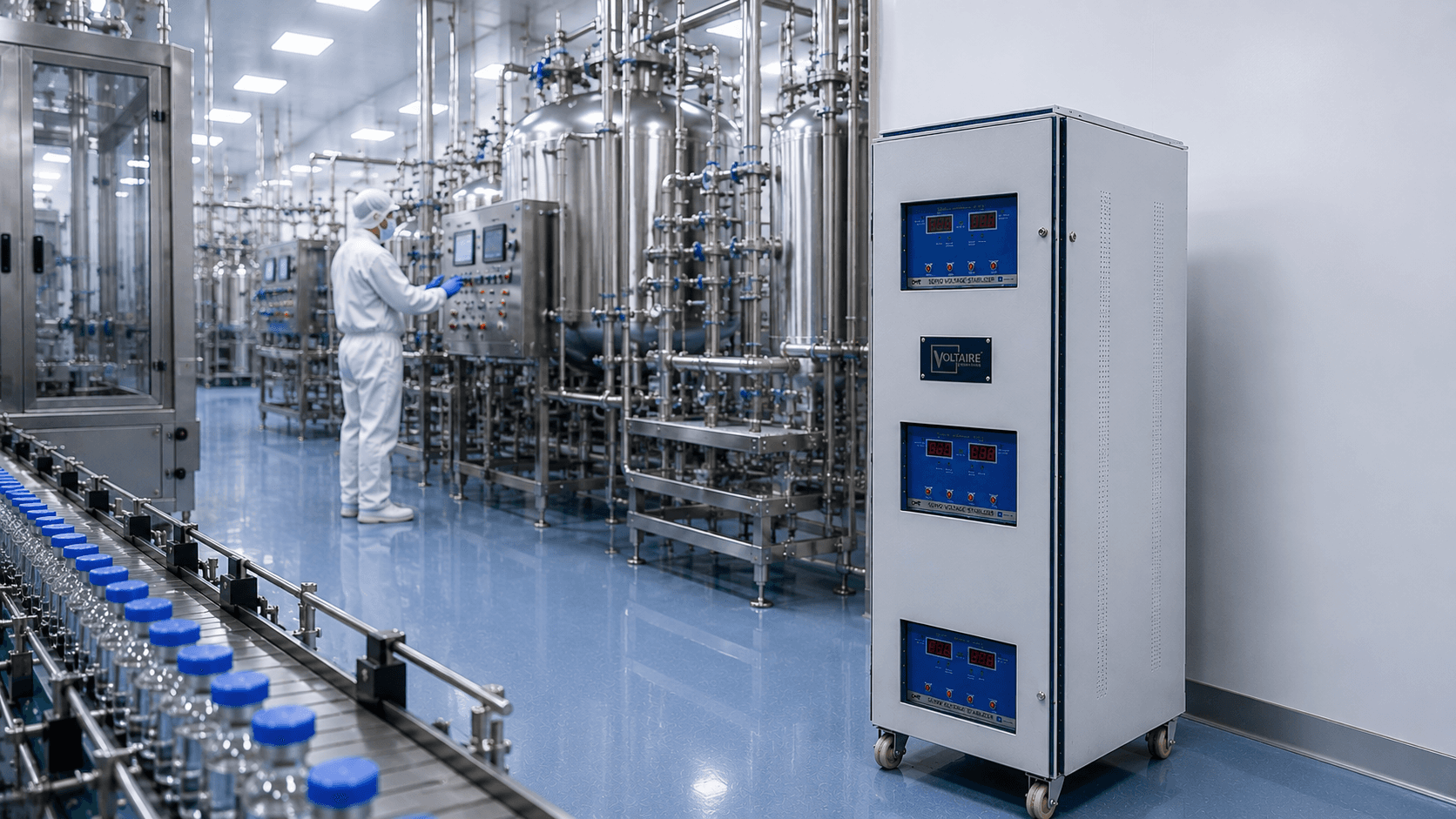
A single voltage event in a pharmaceutical facility does not just trip a machine — it can corrupt an entire batch, trigger a regulatory audit and cost lakhs in rework. This guide explains exactly why voltage stability is non-negotiable in pharma manufacturing and what facility managers need to do about it.
Introduction
Pharmaceutical manufacturing operates under a level of precision that almost no other industry demands. Temperatures must stay within fractions of a degree. Humidity must be controlled to the percentage point. Equipment must run at exact speeds, pressures and timings — consistently, batch after batch.
Every one of these parameters depends on stable electrical power.
Yet voltage fluctuation — one of the most common power quality problems on the Indian grid — is rarely given the same attention as temperature control or humidity management in a pharma facility. It should be.
A voltage event that lasts less than a second can corrupt a batch worth lakhs. It can trigger a regulatory non-conformance. It can damage equipment that takes weeks to replace. And in facilities manufacturing critical medicines, it can have consequences that go far beyond the production floor.
What Voltage Fluctuation Actually Means in a Pharma Context
Voltage fluctuation refers to variations in the supply voltage above or below the standard level — 230V for single phase and 415V for three phase in India.
On the Indian industrial grid, these variations are common and often significant. Voltage at pharma facility sites regularly swings between 360V and 450V during a working day — a variation of more than 20% from the rated supply.
For most industries this causes equipment wear and energy waste. For pharmaceutical manufacturing it causes something far more serious — process instability at the molecular level.
Here is what happens across different areas of a pharma plant when voltage fluctuates:
Clean Room HVAC — The First and Most Critical Risk
The clean room is the heart of any pharmaceutical manufacturing facility. Maintaining the correct air pressure differentials, temperature, humidity and particulate count is not a quality preference — it is a regulatory requirement under Schedule M, WHO GMP and ISO 14644.
All of these parameters are controlled by HVAC systems — Air Handling Units, chillers, cooling towers and precision humidifiers. Every one of these runs on electrical motors and compressors that are sensitive to voltage variation.
When voltage drops, HVAC motors draw excess current to maintain their output. This causes:
Compressors to run hotter than rated, reducing their efficiency and lifespan. Air handling units to deliver inconsistent airflow, disrupting the pressure differentials that keep clean rooms particle-free. Temperature and humidity to drift outside the validated range — even briefly — which constitutes a process deviation under GMP.
A process deviation in a clean room does not just mean rerunning the batch. It means documenting the deviation, conducting a root cause analysis, completing a Corrective and Preventive Action report and potentially notifying the regulatory authority depending on the product and the severity.
The paperwork alone from a single HVAC deviation caused by a voltage event costs more in man-hours than a servo stabilizer costs to purchase and install.
Batch Corruption — The Most Expensive Consequence
Pharmaceutical manufacturing processes are validated. Every parameter — mixing speed, temperature, pressure, coating thickness, drying time — is fixed within a narrow range and approved by the regulatory authority before production begins.
Voltage fluctuation disrupts these parameters mid-process.
Consider a tablet coating line running at night when grid voltage is at its most unstable. A voltage sag reduces the speed of the coating pan motor by 8%. The coating is applied unevenly across the batch. The moisture content of the coating deviates from spec. The batch fails dissolution testing.
The entire batch — potentially thousands of units — is rejected.
The cost of a rejected pharma batch includes:
The raw material cost of the entire batch. The manufacturing labour and overhead already invested. The rework cost if the batch can be salvaged. The regulatory documentation and deviation reporting. The delay to supply chain and product availability.
In a mid-size Indian pharmaceutical facility, a single rejected batch typically costs between ₹5 lakh and ₹50 lakh depending on the product. Active Pharmaceutical Ingredients are particularly expensive — rejection of an API batch can cost crores.
Voltage fluctuation is not listed as the cause in most batch rejection reports. It is listed as "process deviation" or "equipment malfunction." The root cause — unstable power — is rarely investigated unless a power quality audit is specifically conducted.
Precision Equipment — Damage That Does Not Show Immediately
Pharmaceutical manufacturing uses some of the most precise and expensive equipment in any industry. Fluid bed dryers, tablet compression machines, filling and sealing lines, lyophilizers, HPLC systems and automated dispensing equipment all operate with tight electrical tolerances.
Voltage fluctuation affects this equipment in two ways.
Immediate damage occurs during voltage spikes — a sudden surge above rated voltage can damage control boards, sensors and motor drives instantly. This type of damage is obvious because the equipment stops working.
Gradual degradation is more dangerous because it is invisible. Motors running on consistently low voltage draw excess current, generating heat that degrades winding insulation over months. Control systems operating outside their rated voltage range experience component stress that shortens their operational life. Calibrated sensors drift over time when their reference voltage is unstable.
Equipment that should last 10 to 15 years fails in 5 to 7 years in facilities with poor power quality. The replacement cost and production downtime during replacement are rarely attributed to voltage instability — but that is where the damage originated.
Regulatory Compliance — The Risk Nobody Talks About
Schedule M of the Drugs and Cosmetics Act, WHO GMP guidelines and US FDA 21 CFR Part 211 all require pharmaceutical manufacturers to maintain validated environmental and process conditions consistently.
Power quality is an infrastructure requirement that underpins all of these conditions.
If a regulatory inspector finds evidence of repeated process deviations linked to environmental instability — and a power quality audit reveals voltage fluctuation as the root cause — the facility faces:
A critical observation in the inspection report. A requirement to implement corrective action before the next inspection. In severe cases, a warning letter or import alert for facilities seeking international market approvals.
Indian pharma facilities seeking US FDA, EU GMP or WHO prequalification approvals are particularly exposed. These regulators expect infrastructure-level power protection as a baseline. A facility without proper voltage regulation is a facility with a visible gap in its quality infrastructure.
What the Right Solution Looks Like
A servo stabilizer installed at the incoming power supply of a pharmaceutical facility provides continuous, real-time voltage correction — maintaining output voltage within ±1% of the rated level regardless of what the grid supplies.
For a pharma facility specifically, the servo stabilizer specification should include:
Output accuracy of ±1% or better — standard industrial accuracy is not sufficient for pharma applications. Three phase independent correction — pharma facilities typically have unbalanced loads across phases due to the mix of HVAC, production and utility equipment. Bypass provision — for maintenance without interrupting production. Full documentation — test reports, calibration certificates and compliance documentation for inclusion in the facility's qualification records. Oil cooled design for large KVA loads — pharma facilities with central HVAC plants typically require 100 KVA and above.
The servo stabilizer should be included in the facility's equipment qualification process — Installation Qualification and Operational Qualification — so that its performance is documented as part of the validated facility infrastructure.
Conclusion
Voltage fluctuation in a pharmaceutical facility is not an electrical maintenance issue. It is a quality risk, a regulatory risk and a financial risk — all three simultaneously.
The cost of a correctly specified servo stabilizer is a one-time capital expense. The cost of a single batch rejection, a regulatory deviation or an HVAC equipment failure caused by voltage instability is recurring, unpredictable and far higher.
For pharma plant heads, facility managers and EPC consultants specifying power infrastructure for pharmaceutical projects — voltage protection at the incoming supply level is not optional. It is a fundamental requirement of a GMP-compliant facility.
At Voltaire Power Systems we supply servo stabilizers specifically configured for pharmaceutical manufacturing environments — with the accuracy, documentation and certification that pharma quality teams require.
📞 Contact us to discuss your facility's power protection requirement before your next regulatory audit.
Key Terms
Important Points
Core lessons & insights
HVAC systems in clean rooms are the first and most critical casualty of voltage fluctuation — even brief deviations trigger GMP non-conformances that require documentation and corrective action
Batch rejection caused by voltage-related process deviations costs between ₹5 lakh and ₹50 lakh per incident in a mid-size Indian pharma facility
Gradual equipment degradation from voltage instability is invisible until failure — equipment that should last 15 years fails in 5 to 7 years in facilities with poor power quality
Regulatory inspectors from US FDA, EU GMP and WHO expect infrastructure-level power protection as a baseline — a facility without it has a visible gap in its quality infrastructure
Servo stabilizers for pharma must be specified at ±1% output accuracy or better and included in the facility's IQ and OQ qualification records
Did this help?
May 14, 2026
Written by
Sarvesh
Director