100 kVA Distribution Transformer (33kV)
Industrial-grade 100 kVA distribution transformer stepping down 33kV to 415V for larger power distribution networks. Built for durability and efficiency in demanding electrical environments.
Ref. DIST-100-33KV · Lead time 6–8 weeks · Made to order from Hapur
See full engineering specification & variants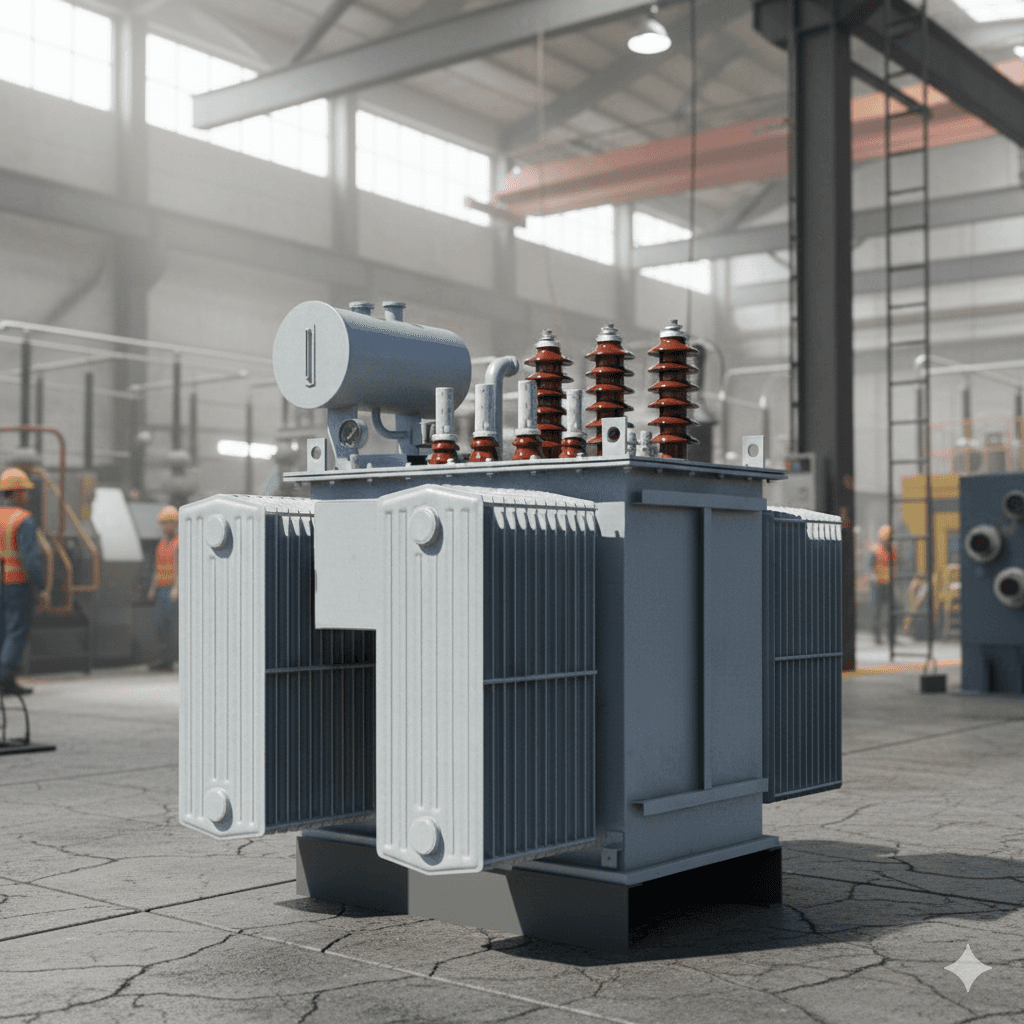
Key Features
Recommended For
Specifications
| Specification | Value |
|---|---|
| Capacity | 100 kVA |
| Primary Voltage | 33000V (±5%) |
| Secondary Voltage | 415V (±5%) |
| Frequency | 50 Hz |
| Tap Changer | On-load ±2 × 2.5% |
| Cooling Method | both air and oil cooled |
| Copper Loss | ~1700W |
| Iron Loss | ~700W |
Reading the specification
What these numbers mean for your installation
A datasheet tells you what the unit does. This is what each figure changes about how you specify, feed and site it — worked out for the 100 kVA specifically, not the range in general.
6,132 kWh/year
Iron loss of 700 W is drawn whenever the transformer is energised, whether or not anything is connected. Over a year that is 6,132 kWh — about ₹49,056 at ₹8/kWh. It is the figure worth comparing between quotes, because you pay it for the full 25-year life regardless of load.
97.4%
At full load and 0.9 power factor, total losses of 2,400 W give roughly 97.4% efficiency. Copper loss varies with the square of load, so a transformer run at half capacity dissipates about a quarter of that 1,700 W — oversizing costs you standing loss, not copper loss.
33000V
At this rating the 33 kV yard is a meaningful share of total project cost, and it scales with voltage class rather than with capacity. That is worth knowing before you finalise the rating: the incremental cost of a larger transformer is small next to the yard you are building either way. Confirm the sanctioned voltage with the DISCOM first — a 33 kV unit cannot be fed from an 11 kV line.
On-load ±2 × 2.5%
The tap changer trims the ratio across roughly 31.35–34.65 kV on the primary, which is what holds your 415 V board steady when the incoming supply sits persistently high or low. Note that it corrects a standing offset only. Second-by-second fluctuation is a servo stabilizer's job, and no tap changer substitutes for one.
Running-cost figures assume a reference industrial tariff of ₹8/kWh and continuous energisation. Substitute your own tariff and duty hours for a site-specific number — we will run it with you on request.
Sizing Guide
When is 100 kVA the right choice?
100 kVA on a 33 kV primary is a deliberate choice, and usually a constrained one. At this load 11 kV would be the conventional supply — 33 kV is specified when that is what the DISCOM sanctioned at your location, typically an industrial corridor or a site fed from a 33 kV feeder with no 11 kV network nearby. The on-load tap changer matters more here than it would at 11 kV, because 33 kV feeders run long and the voltage at the far end drifts seasonally; the taps trim that standing offset across roughly 31.35–34.65 kV on the primary. What they will not do is respond to second-by-second fluctuation. If your machines are tripping on dips, the fix is a servo stabilizer downstream, not a different transformer.
Before you order
Where 100 kVA goes in, and what the site needs
Typical installations
We supply 100 kVA most often into large industrial complexes, power distribution networks, utility grid substations and manufacturing clusters, alongside hospital power centers and data center primary feeders. What separates those sites is load factor. A transformer serving a steady process load and one serving a facility with a sharp evening peak have very different loss profiles over a year, even at an identical nameplate rating.
Statutory requirements
A 33 kV primary connection falls under CEA safety regulations: approved HT switchgear, earthing and statutory clearances, drawings submitted to the electrical inspector, and a certified operator for switching. Build that approval time into your programme — it routinely exceeds our 6–8 weeks manufacturing lead time, and it is the step that delays energisation far more often than the transformer does.
Adjacent ratings
If 100 kVA is not the right size
Sizing rarely lands exactly on a catalogue rating first time. These are the ratings either side of it in the same range — compare the specification before you commit.
63 kVA Distribution Transformer (11kV)
63 kVA distribution transformer for medium-scale power distribution.
View specificationDistribution Transformer160 kVA Distribution Transformer (33kV)
160 kVA distribution transformer for medium-scale grid integration.
View specificationDistribution Transformer25 kVA Distribution Transformer (11kV)
Standard distribution transformer for 25 kVA load, 11kV primary voltage.
View specificationDistribution Transformer250 kVA Distribution Transformer (33kV)
Extra-large capacity distribution transformer for comprehensive power distribution.
View specificationAlso in the transformer range
Different equipment rather than a different size — often specified alongside this on the same project.
50 kVA Three-Phase Ultra-Isolation Transformer
Industrial three-phase ultra-isolation transformer with advanced noise suppression.
View specificationIsolation Transformer20 kVA Three-Phase Isolation Transformer
Three-phase 20 kVA isolation transformer for medium-load equipment protection.
View specificationIsolation Transformer10 kVA Single-Phase Isolation Transformer
High-isolation single-phase transformer for sensitive electronic equipment protection.
View specificationEngineering detail on this configuration
The distribution transformer pages carry the full design rationale, comparison tables and application notes behind this SKU.
Ready to specify?
Share your load profile. Get a firm proposal in 24 hours.
Send us your kVA requirement, supply voltage range, and site conditions. Our engineer will confirm whether this configuration is correct for your installation, or specify an alternative if needed. No distributors — direct from our factory in Hapur.
Submit load requirements