175 kVA Servo Voltage Stabilizer
The 175 kVA Servo Voltage Stabilizer delivers superior voltage stability for established manufacturing facilities. Features advanced servo motor control with rapid response to grid fluctuations.
Ref. SVS-175-3PH · Lead time 2 weeks · Made to order from Hapur
See full engineering specification & variants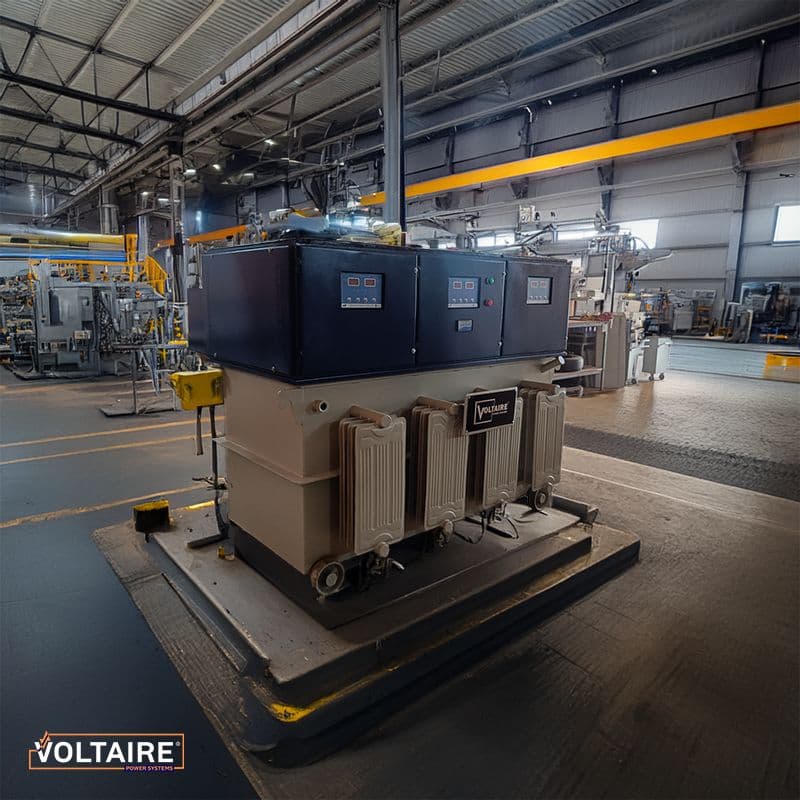
Key Features
Recommended For
Specifications
| Specification | Value |
|---|---|
| Capacity | 175 kVA |
| Input Voltage | 300V–470V, 3-Phase |
| Output Voltage | 415V ±1% |
| Frequency | 50/60 Hz |
| Response Time | < 20 ms |
| Cooling Method | both air and oil cooled |
| Weight | 690 kg |
| Warranty | 3 years |
Reading the specification
What these numbers mean for your installation
A datasheet tells you what the unit does. This is what each figure changes about how you specify, feed and site it — worked out for the 175 kVA specifically, not the range in general.
243 A per phase
At 415 V three-phase, 175 kVA works out at roughly 243 A per phase. Terminate this into the stabilizer's own cable chamber via a gland plate. Check the plate is drilled for your cable diameter before delivery, and size the upstream breaker at 304 A so the protection device is never the limiting element in the feed.
300V–470V
The unit holds output at 415V ±1% anywhere between 300 V and 470 V in. Pulling a 300 V supply back up to 415 V means adding 115 V — a 38% lift on the incoming supply, with the series winding carrying roughly 48 kVA of the 175 kVA throughput. Below 300 V it runs out of range, and the answer is a wider-window build, not more kVA.
< 20 ms
< 20 ms matters more than the ±1% accuracy figure for most buyers. The failure that actually costs you is a drive faulting on undervoltage when a large motor elsewhere on the feeder starts, and correction inside < 20 ms is what prevents it.
150% for 30 minutes
Direct-on-line starting draws six to eight times full-load current for a few seconds, and 150% for 30 minutes is the margin that absorbs it. Keep steady-state load below about 80% of 175 kVA so this headroom is still available when the largest motor starts.
Sizing Guide
When is 175 kVA the right choice?
175 kVA bridges the gap between the standard 150 kVA and 200 kVA sizes and is most often specified by electrical consultants working with precise load calculations rather than rounding up. A typical use case: a textile weaving facility with 10 rapier looms at 12 kW each plus humidification, compressed air, and lighting totalling 168 kVA — a 150 kVA unit would be overloaded and a 200 kVA unit would run at 84% load which is acceptable but wastes capital. Precision machine shops with multiple 5-axis machining centres also cluster in this range, particularly where dust extraction and coolant chillers are included in the same stabilizer feed.
Before you order
Where 175 kVA goes in, and what the site needs
Typical installations
We supply 175 kVA most often into large manufacturing plants, textile mills, automotive facilities and precision laboratories, alongside industrial complexes and heavy-duty assembly lines. What separates those sites is duty cycle rather than load. A rating that runs cool on single-shift work sits near the top of its thermal range on a continuous three-shift line, and that is the point at which oil cooling stops being optional.
Site preparation
At 690 kg you need a pallet truck at minimum and a level, load-spreading base. Check the route for ramp gradients — a hydraulic truck carrying 690 kg will not climb much of one. Leave working clearance on the terminal side for cable entry and inspection. Sustained ambient above 45 °C, or an enclosed room without cross-ventilation, requires derating — send us the room conditions and we will confirm the rating still holds where you intend to put it.
Adjacent ratings
If 175 kVA is not the right size
Sizing rarely lands exactly on a catalogue rating first time. These are the ratings either side of it in the same range — compare the specification before you commit.
150 kVA Servo Voltage Stabilizer
Compact servo stabilizer for 150 kVA industrial operations.
View specificationServo Voltage Stabilizer200 kVA Servo Voltage Stabilizer
Enterprise-grade servo stabilizer for 200 kVA heavy industrial loads.
View specificationServo Voltage Stabilizer125 kVA Servo Voltage Stabilizer
Precision servo stabilizer for 125 kVA industrial loads with enhanced voltage control.
View specificationServo Voltage Stabilizer225 kVA Servo Voltage Stabilizer
High-performance servo stabilizer for 225 kVA industrial facilities.
View specificationServo Voltage Stabilizer100 kVA Servo Voltage Stabilizer
Industrial-grade servo voltage stabilizer for 100 kVA loads with precise voltage control.
View specificationServo Voltage Stabilizer250 kVA Servo Voltage Stabilizer
Heavy-duty servo stabilizer designed for 250 kVA industrial operations.
View specificationEngineering detail on this configuration
The servo voltage stabilizer pages carry the full design rationale, comparison tables and application notes behind this SKU.
Ready to specify?
Share your load profile. Get a firm proposal in 24 hours.
Send us your kVA requirement, supply voltage range, and site conditions. Our engineer will confirm whether this configuration is correct for your installation, or specify an alternative if needed. No distributors — direct from our factory in Hapur.
Submit load requirements