750 kVA Servo Voltage Stabilizer
The 750 kVA Servo Voltage Stabilizer represents the pinnacle of servo voltage stabilization technology. Built for mission-critical large-scale industrial operations.
Ref. SVS-750-3PH · Lead time 3–4 weeks · Made to order from Hapur
See full engineering specification & variants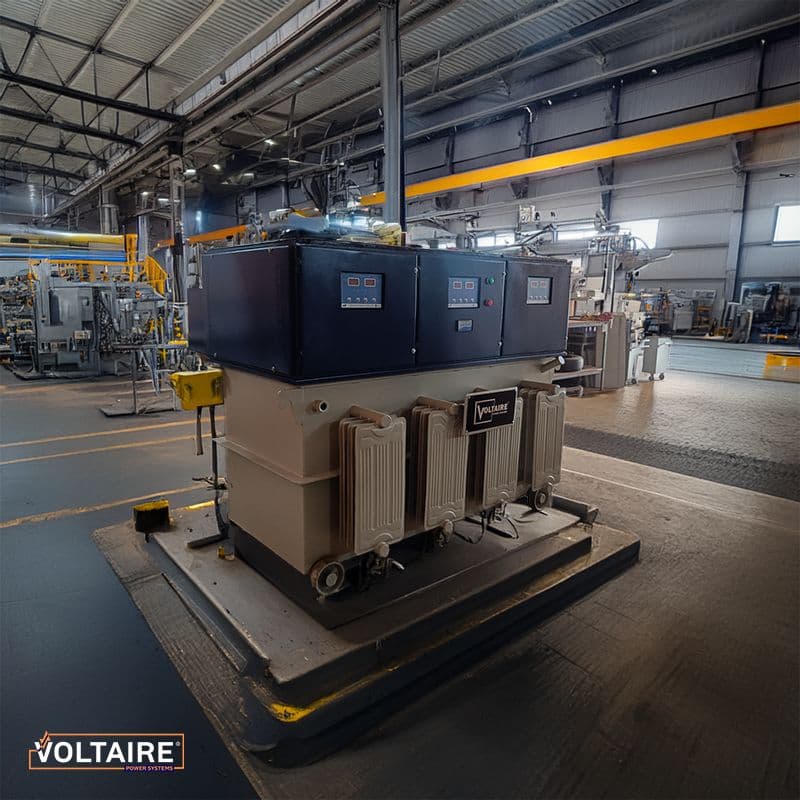
Key Features
Recommended For
Specifications
| Specification | Value |
|---|---|
| Capacity | 750 kVA |
| Input Voltage | 300V–470V, 3-Phase |
| Output Voltage | 415V ±1% |
| Frequency | 50/60 Hz |
| Response Time | < 20 ms |
| Cooling Method | both air and oil cooled |
| Weight | 2900 kg |
| Warranty | 3 years |
Reading the specification
What these numbers mean for your installation
A datasheet tells you what the unit does. This is what each figure changes about how you specify, feed and site it — worked out for the 750 kVA specifically, not the range in general.
1,043 A per phase
At 415 V three-phase, 750 kVA works out at roughly 1,043 A per phase. 1,043 A is a substation-scale connection. Cable is no longer sensible: this terminates on busduct, and the connection design — bar sizing, joint torque, thermal expansion allowance over the run — becomes a piece of engineering in its own right rather than a cable schedule. We supply the termination arrangement with the unit so the interface is settled before either side is built.
300V–470V
The unit holds output at 415V ±1% anywhere between 300 V and 470 V in. Pulling a 300 V supply back up to 415 V means adding 115 V — a 38% lift on the incoming supply, with the series winding carrying roughly 208 kVA of the 750 kVA throughput. Below 300 V it runs out of range, and the answer is a wider-window build, not more kVA.
< 20 ms
At this scale the stabilizer is effectively part of the incoming supply rather than a device hanging off it, and < 20 ms is what stops a disturbance anywhere in the plant from becoming a disturbance everywhere. Sites at this rating usually want the correction logged as well as performed — the remote monitoring option exists for exactly that.
150% for 30 minutes
Direct-on-line starting draws six to eight times full-load current for a few seconds, and 150% for 30 minutes is the margin that absorbs it. At 750 kVA the practical constraint is usually the largest single motor rather than the total: size against that starting current, not against the sum of the nameplates.
Sizing Guide
When is 750 kVA the right choice?
750 kVA is the correct stabilizer size when the site has a 630A TPN main incomer and the plant engineer wants to protect 100% of the downstream load. Steel rolling mills with one or two rolling stands, large glass manufacturing plants with annealing lehrs and cutting tables, and industrial parks with a shared power infrastructure where 8–10 SME tenants are fed from one stabilized bus all specify this rating. At 750 kVA, the unit weight exceeds 2,900 kg — civil foundation design and transport logistics are part of the procurement scope, and our team provides a floor loading drawing and transport route assessment as part of the order package.
Before you order
Where 750 kVA goes in, and what the site needs
Typical installations
We supply 750 kVA most often into mega manufacturing facilities, steel mills, chemical processing plants and automotive manufacturing, alongside textile mills and industrial power substations. What separates those sites is duty cycle rather than load. A rating that runs cool on single-shift work sits near the top of its thermal range on a continuous three-shift line, and that is the point at which oil cooling stops being optional.
Site preparation
At 2,900 kg this is a crane lift onto an engineered foundation, and it needs a structural opinion rather than an assumption — over this footprint the point load, not the total mass, is what governs. Settle the lifting plan and access route at order stage; 2,900 kg cannot be repositioned once it is down. Leave working clearance on the terminal side for cable entry and inspection. Sustained ambient above 45 °C, or an enclosed room without cross-ventilation, requires derating — send us the room conditions and we will confirm the rating still holds where you intend to put it.
Adjacent ratings
If 750 kVA is not the right size
Sizing rarely lands exactly on a catalogue rating first time. These are the ratings either side of it in the same range — compare the specification before you commit.
600 kVA Servo Voltage Stabilizer
Ultra-high capacity servo stabilizer for 600 kVA operations.
View specificationServo Voltage Stabilizer500 kVA Servo Voltage Stabilizer
Heavy-duty servo stabilizer for large industrial loads up to 500 kVA.
View specificationServo Voltage Stabilizer1000 kVA Servo Voltage Stabilizer
Maximum capacity servo stabilizer for critical industrial infrastructure.
View specificationServo Voltage Stabilizer450 kVA Servo Voltage Stabilizer
Specialized servo stabilizer for 450 kVA industrial complexes.
View specificationServo Voltage Stabilizer400 kVA Servo Voltage Stabilizer
High-capacity servo stabilizer for 400 kVA large-scale operations.
View specificationServo Voltage Stabilizer350 kVA Servo Voltage Stabilizer
Premium servo stabilizer for 350 kVA industrial power conditioning.
View specificationEngineering detail on this configuration
The servo voltage stabilizer pages carry the full design rationale, comparison tables and application notes behind this SKU.
Ready to specify?
Share your load profile. Get a firm proposal in 24 hours.
Send us your kVA requirement, supply voltage range, and site conditions. Our engineer will confirm whether this configuration is correct for your installation, or specify an alternative if needed. No distributors — direct from our factory in Hapur.
Submit load requirements